Subjects = Social Sciences
Number of Articles: 6
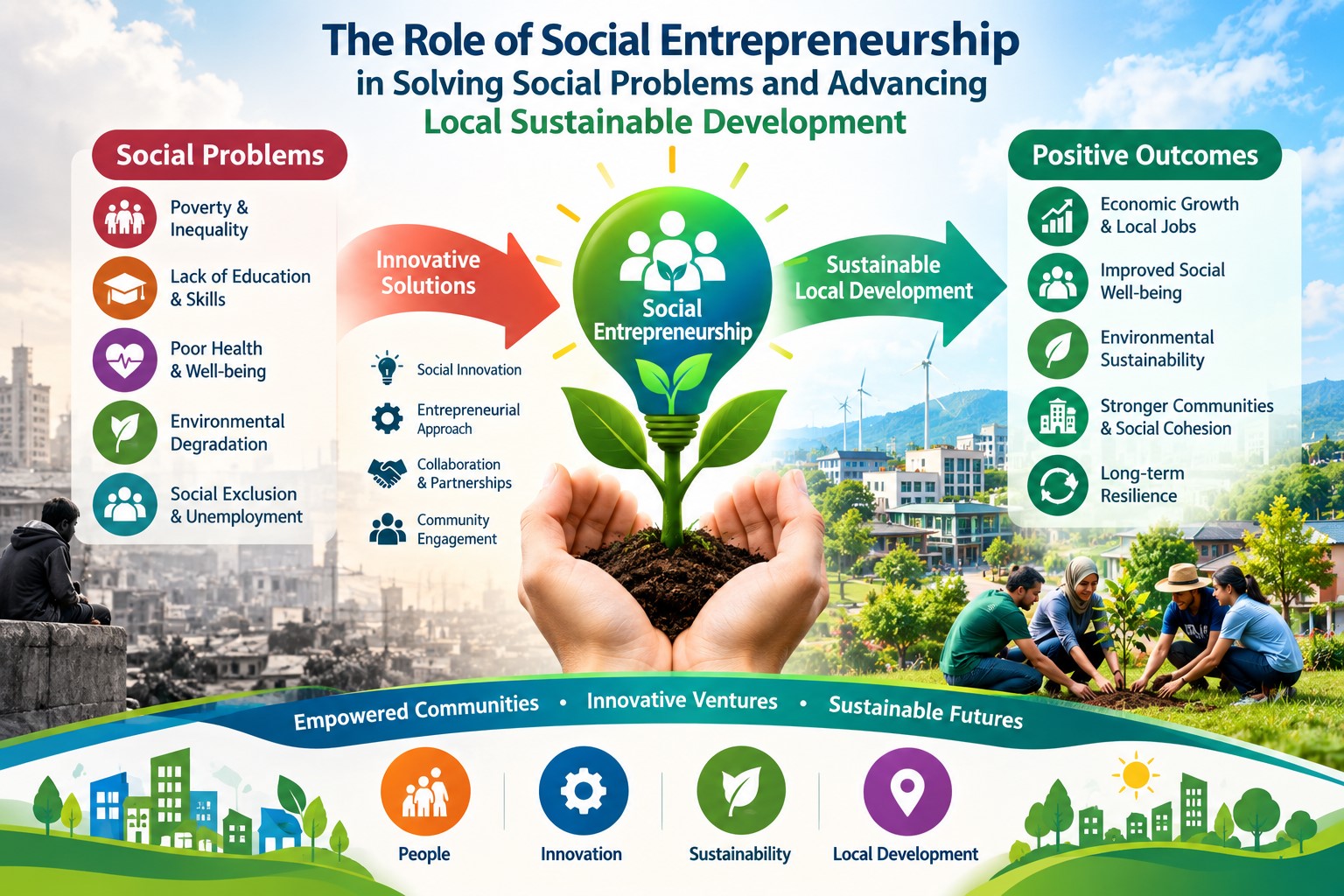
The Role of Social Entrepreneurship in Solving Social Problems and Advancing Local Sustainable Development

The Role of Social Entrepreneurship in Solving Social Problems and Advancing Local Sustainable Development

Volume 2, Issue 5, September and October 2026, Pages 498-516

https://doi.org/10.5281/zenodo.23862344

Amirhossein Rahimian

Abstract Social entrepreneurship occupies an increasingly important position between public service provision, community action and market coordination. Yet its contribution to local sustainable development is often described through success narratives rather than explicit causal mechanisms or comparable outcome measures. This integrative critical review synthesizes recent peer-reviewed research and authoritative institutional publications released during 2024–2026. Rather than presenting a new field experiment, it identifies and evaluates six mechanisms linking mission-oriented enterprise to local outcomes: access to essential services, inclusive employment, community wealth retention, social capital and participatory governance, environmental innovation, and adaptive resilience. Evidence from rural enterprise evaluation, urban township case studies, comparative organizational research, and international policy reports indicates that social ventures can address specific local market and institutional failures, especially when beneficiaries participate in design and governance. However, impact remains conditional on organizational sustainability, the distribution of benefits, external public systems, and credible counterfactual measurement. The review develops a place-based logic model, proposes a multidimensional evaluation dashboard, and specifies a practical policy sequence for municipal and regional ecosystems. It concludes that social entrepreneurship is best understood as a complement to, not a substitute for, equitable public institutions and structural reform. Future studies should prioritize longitudinal designs, geographically explicit spillovers, disaggregated distributional analysis, and more transparent impact claims.

Investigating the Role of Social Trust in Establishing Security in Society

Investigating the Role of Social Trust in Establishing Security in Society

Volume 2, Issue 3, May and June 2026, Pages 253-260

https://doi.org/10.5281/zenodo.21863576

Elahe Mozani

Abstract Social trust is recognized as one of the most fundamental instruments for strengthening security. It refers to the reciprocal relationships and levels of cooperation among individuals and groups within a society. Security, understood as freedom from fear and danger and the sense of being free from any threat, has been one of the primary and essential human needs since the dawn of human life. Security in this sense has a profound connection with the economic, social, and cultural structures of society. Therefore, the feeling of security is shaped by various factors, one of which is social capital. Social capital consists of multiple components, among which social trust is recognized as one of the most influential in enhancing the level of social security in society. In other words, social trust functions as a key factor in strengthening social bonds, and these bonds play an important role in establishing security in society. These bonds include family, friendship, neighborhood, and even organizational relationships, which, by creating a sense of shared ownership and responsibility toward others, reinforce security. Furthermore, social security, as a guarantor of individual and social rights and interests and a source of peace and comfort for members of society, is contingent upon social trust. Ultimately, awareness of the state of security perception among residents of a community plays an effective role in identifying challenges and development strategies and in strengthening the infrastructure of that community.

A Sociological Investigation of Social Anxiety in the Risk Age: A Documentary Analysis of Environmental Insecurity and Digital Insecurity in the Contemporary World

A Sociological Investigation of Social Anxiety in the Risk Age: A Documentary Analysis of Environmental Insecurity and Digital Insecurity in the Contemporary World

Volume 2, Issue 2, March and April 2026, Pages 199-208

https://doi.org/10.5281/zenodo.21853700

Elahe Mozani

Abstract The present study, entitled "A Sociological Investigation of Social Anxiety in the Risk Age: In recent decades, human society has increasingly confronted two fundamental forms of insecurity: first, environmental crises such as climate change, drought, air pollution, and the depletion of natural resources, which pose a serious threat to human life; and second, digital insecurities including cyberattacks, privacy violations, and the expansion of technological surveillance, which undermine the psychological and social security of individuals. These two domains appear distinct on the surface, yet at a deeper level they converge on a common point: the production of social anxiety and the reproduction of fear of an uncertain future. Employing a documentary analysis approach within the theoretical framework of Ulrich Beck's "Risk Society" and the sociology of emotions, this research investigates the representation of environmental and digital insecurities in scientific, media, and policy documents. The findings indicate that social anxiety is not merely an individual reaction but a social and structural phenomenon reproduced through the salience of threats in public discourse and deficiencies in institutional management. Furthermore, the results demonstrate that factors such as policy transparency, enhancement of environmental and digital literacy, institutional trust, social capital, and resilience education can play a fundamental role in reducing social anxiety. Based on the findings, it can be asserted that social anxiety in the risk age reflects the manner in which societies confront modern threats, and its management requires a combination of sustainable environmental policies, efficient digital security, and the strengthening of cultural and social capacities. This study, by revealing the sociological dimensions of social anxiety, can contribute to the design of effective social and cultural policies aimed at mitigating the psychological and social consequences of contemporary threats.

Biomechanical Analysis of Running Gait Patterns: The Relationship Between Foot Strike Type, Injury Prevalence, and Performance Efficiency in Long-Distance Runners

Biomechanical Analysis of Running Gait Patterns: The Relationship Between Foot Strike Type, Injury Prevalence, and Performance Efficiency in Long-Distance Runners

Volume 1, Issue 9, September 2025, Pages 587-595

https://doi.org/10.5281/zenodo.17544163

Mohammad Almasi

Abstract Understanding the biomechanical characteristics of running gait patterns is essential for optimizing performance and minimizing injury risk among long-distance runners. This study aimed to analyze the relationship between foot strike type—classified as rearfoot, midfoot, and forefoot strike—and both injury prevalence and running efficiency. A total of 60 trained long-distance runners (30 male, 30 female) were examined using 3D motion capture and ground reaction force analysis during standardized treadmill running sessions. Kinematic and kinetic parameters, including stride length, contact time, loading rate, and vertical stiffness, were compared across foot strike patterns. Statistical analysis revealed that rearfoot strikers exhibited higher vertical impact forces and greater incidence of overuse injuries, particularly in the knee and hip regions, whereas forefoot strikers demonstrated reduced impact loading but increased calf and Achilles tendon stress. Midfoot strikers showed the most balanced biomechanical profile, with moderate impact forces and optimal running economy. The findings suggest that individualized gait assessment and training interventions tailored to foot strike patterns can enhance performance efficiency while reducing injury risk in long-distance runners.

Solutions to Improve Shelf Life and Quality of Food Products with New Technologies

Solutions to Improve Shelf Life and Quality of Food Products with New Technologies

Volume 1, Issue 3, March 2025, Pages 117-124

https://doi.org/10.5281/zenodo.15555125

Samaneh Moravej

Abstract Today, with the growth of population and changing consumption patterns, the demand for food products with longer shelf life and higher quality has increased. Food spoilage caused by microbial factors, oxidation and enzymatic activity leads to significant food waste and economic losses every year. Therefore, the use of new technologies is essential to maintain the quality and increase the shelf life of food products. With the increasing demand for safe and high-quality food products, the use of new technologies in the food industry has become essential to improve the shelf life and quality of products. This review article examines new technologies such as smart packaging, nanotechnology, non-thermal processing such as high-pressure pasteurization and electrical pulses, and the use of natural antimicrobial materials. The results show that these technologies not only increase the shelf life of products, but also maintain their nutritional and sensory quality. The challenges in applying these technologies and possible solutions to overcome them are also discussed.

Understanding Deviance: Social Norms and the Consequences of Nonconformity

Understanding Deviance: Social Norms and the Consequences of Nonconformity

Volume 1, Issue 3, March 2025, Pages 125-138

https://doi.org/10.5281/zenodo.15554779

Vahid Jadidi

Abstract Social abnormalities are one of the manifestations of civilization and social living. It is obvious that where a group lives together, there will also be a discussion about social abnormalities, and social abnormalities are the result of the social environment. If the social environment establishes a relationship by forming correct social relations and creating a harmonious and balanced structure between desires and possibilities and between means and goals, and uses the culture of the society to form such a context, the behavior of the people of the society will be directed towards fulfilling the desires of the social system and the individuals. Social abnormalities are those social deviations that the custom of the society considers as deviations from norms, but written laws have not considered them as examples of crimes and punishable. Social misconduct refers to a person who does not fall within the framework of moral principles and general rules of collective action existing in the society where the activist is active. Therefore, he faces legal prohibition and moral and social ugliness. In fact, people who conform to the norms and values of society are called normal, and people who do not conform are called abnormal, and among abnormal people, someone whose abnormal behavior is not fleeting and lasts for a long time is called deviant or deviant. Social deviance refers to any behavior that a person performs contrary to social norms and forms, disrupts his or her functioning, and consequently affects the functioning of the family and society.