The Effectiveness of Acceptance and Commitment Therapy on Reducing Depression and Increasing Quality of Life in Patients with Chronic Pain

Document Type : Original Article

Author

Department of Epidemiology and Biostatistics, School of Public Health, Tehran University of Medical Sciences, Tehran, Iran

10.5281/zenodo.22830874
Abstract
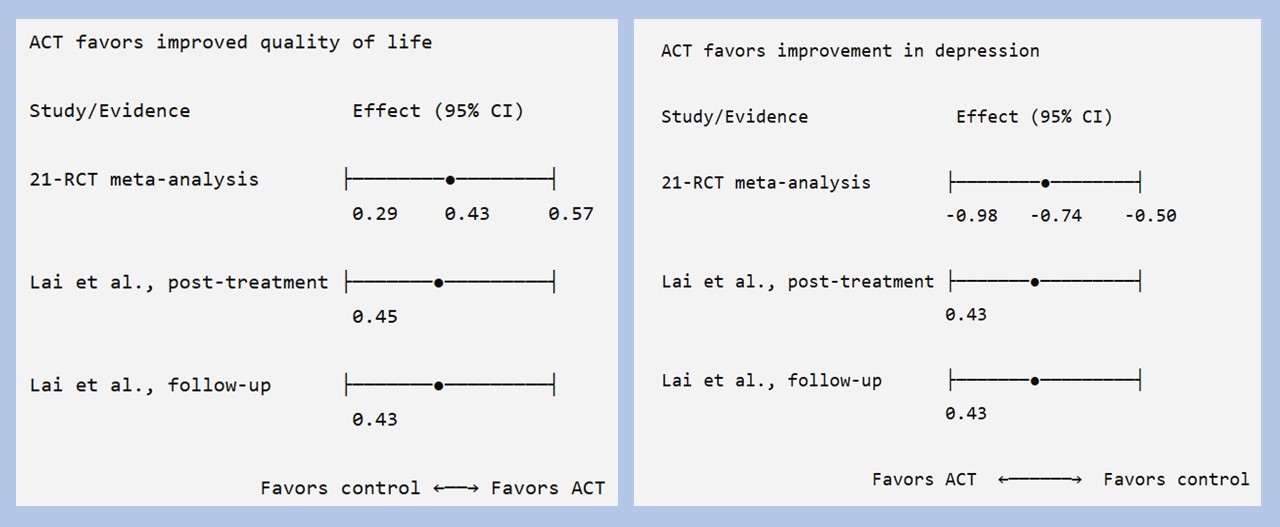
Chronic pain is a prevalent and disabling health condition that is frequently accompanied by depression, emotional distress, functional impairment, and reduced quality of life. Acceptance and Commitment Therapy (ACT) has emerged as a contextual behavioral intervention designed to improve psychological flexibility, facilitate acceptance of unpleasant internal experiences, and promote engagement in personally meaningful activities despite pain. The present systematic review and meta-analytic synthesis examined the effectiveness of ACT in reducing depressive symptoms and improving quality of life among adults with chronic pain. Published randomized controlled trials and previous systematic reviews and meta-analyses investigating ACT for chronic pain were considered. The evidence indicates that ACT produces clinically meaningful improvements in psychological and quality-of-life outcomes compared with usual care, waiting-list conditions, and, in some studies, active psychological interventions. Across a three-level meta-analysis involving 33 randomized controlled trials and 2,293 participants, ACT demonstrated significant effects on depression (Hedges' g = 0.43) and quality of life (g = 0.45) immediately after treatment. Similar effects were observed at follow-up, with pooled effects of g = 0.43 for depression and g = 0.43 for quality of life. Another meta-analysis of 21 trials involving 1,962 participants reported a standardized mean difference of −0.74 for depression and 0.43 for quality of life, favoring ACT. These findings suggest that ACT may be particularly valuable because it does not require pain elimination as a prerequisite for recovery. Instead, it targets psychological flexibility, acceptance, values-based behavior, and meaningful engagement. Overall, ACT appears to be an effective psychological intervention for reducing depression and enhancing quality of life in people living with chronic pain, although heterogeneity in intervention format, diagnosis, comparator condition, treatment duration, and follow-up period should be considered when interpreting the evidence.

Graphical Abstract

The Effectiveness of Acceptance and Commitment Therapy on Reducing Depression and Increasing Quality of Life in Patients with Chronic Pain

Keywords

Subjects

[1]    Buhrman, M., Skoglund, A., Husell, J., Bergström, K., Gordh, T., Hursti, T., Bendelin, N., Furmark, T., & Andersson, G. (2013). Guided internet-delivered acceptance and commitment therapy for chronic pain patients: A randomized controlled trial. Behaviour Research and Therapy, 51(6), 307-315.             
[2]    Hughes, L. S., Clark, J., Colclough, J. A., Dale, E., & McMillan, D. (2017). Acceptance and Commitment Therapy (ACT) for chronic pain: A systematic review and meta-analyses. The Clinical Journal of Pain, 33(6), 552-568.
[3]    Lai, L., Liu, Y., McCracken, L. M., Li, Y., & Ren, Z. (2023). The efficacy of acceptance and commitment therapy for chronic pain: A three-level meta-analysis and a trial sequential analysis of randomized controlled trials. Behaviour Research and Therapy, 165, 104308.
[4]    McCracken, L. M., & Vowles, K. E. (2014). Acceptance and Commitment Therapy and mindfulness for chronic pain: Model, process, and progress. American Psychologist, 69(2), 178-187.
[6]    McCracken, L. M., Sato, A., & Taylor, G. J. (2013). A trial of a brief group-based form of Acceptance and Commitment Therapy (ACT) for chronic pain in general practice: Pilot outcome and process results. The Journal of Pain, 14(11), 1398-1406.  
[7]    Vowles, K. E., & McCracken, L. M. (2008). Acceptance and values-based action in chronic pain: A study of treatment effectiveness and process. Journal of Consulting and Clinical Psychology, 76(3), 397-407.     
[8]    Vowles, K. E., McCracken, L. M., & Eccleston, C. (2007). Processes of change in treatment for chronic pain: The contributions of pain, acceptance, and catastrophizing. European Journal of Pain, 11(7), 779-787. 
[9]    Vowles, K. E., McCracken, L. M., & O'Brien, J. Z. (2011). Acceptance and values-based action in chronic pain: A three-year follow-up analysis of treatment effectiveness and process. Behaviour Research and Therapy, 49(11), 748-755.
[10] Vowles, K. E., Witkiewicz, K., Sowden, G., & Ashworth, J. (2014). Acceptance and Commitment Therapy for chronic pain: Evidence of mediation and clinically significant change following an abbreviated interdisciplinary program of rehabilitation. The Journal of Pain, 15(1), 101-113.             
[11] Vowles, K. E., Sowden, G., & Ashworth, J. (2014). A comprehensive examination of the model underlying Acceptance and Commitment Therapy for chronic pain. Behavior Therapy, 45(3), 390-401. 
[12] Wetherell, J. L., Afari, N., Rutledge, T., Sorrell, J. T., Stoddard, J. A., Petkus, A. J., Solomon, B. C., Lehman, D. H., Liu, L., Lang, A. J., & Atkinson, J. H. (2011). A randomized, controlled trial of Acceptance and Commitment Therapy and cognitive-behavioral therapy for chronic pain. Pain, 152(9), 2098-2107.        
[13] Wicksell, R. K., Kemani, M., Jensen, K., Kosek, E., Kadet off, D., Sorjonen, K., Ingvar, M., & Olsson, G. L. (2013). Acceptance and Commitment Therapy for fibromyalgia: A randomized controlled trial. European Journal of Pain, 17(4), 599-611.   
[14] Scott, W., Hann, K. E. J., & McCracken, L. M. (2016). A comprehensive examination of changes in psychological flexibility following Acceptance and Commitment Therapy for chronic pain. Journal of Contemporary Psychotherapy, 46, 139-148.       
[15] Vowles, K. E., McCracken, L. M., Sowden, G., & Ashworth, J. (2014). Psychological flexibility in coping with chronic pain: Further examination of the Brief Pain Coping Inventory-2. The Clinical Journal of Pain, 30(4), 324-330.            
[16] Vowles, K. E., McCracken, L. M., & Eccleston, C. (2004). Acceptance of chronic pain: Component analysis and a revised assessment method. Pain, 107(1–2), 159-166.     
[17] Steiner, J. L., Bogusch, L., & Bigatti, S. M. (2013). Values-based action in fibromyalgia: Results from a randomized pilot of Acceptance and Commitment Therapy. Health Psychology Research, 1(3), e34.         
[18] Ye, L., Li, Y., Deng, Q., Zhao, X., Zhong, L., & Yang, L. (2024). Acceptance and Commitment Therapy for patients with chronic pain: A systematic review and meta-analysis on psychological outcomes and quality of life. PLOS ONE, 19(6), e0301226.       
[19] Martinez-Calderon, J., García-Muñoz, C., Rufo-Barbero, C., Matias-Soto, J., & Cano-García, F. J. (2024). Acceptance and Commitment Therapy for chronic pain: An overview of systematic reviews with meta-analysis of randomized clinical trials. The Journal of Pain, 25(3), 595-617.             
[20] Zhao, B., Wang, Q., & Wang, L. (2023). Effect of Acceptance and Commitment Therapy for depressive disorders: A meta-analysis. BMC Psychology, 11, 34.         
[21] Etzelmüller, A., Barke, A., Feiler, M., Guth, M., Heber, E., Baumeister, H., & Ebert, D. D. (2026). Digital Acceptance and Commitment Therapy for the treatment of chronic pain: Findings of a randomized controlled efficacy trial. Deutsches Ärzte blatt International, 123(6), 149-156.
[22] Vowles, K. E., Fink, B. C., & Cohen, L. L. (2014). Acceptance and Commitment Therapy for chronic pain: A diary study of treatment process in relation to reliable change in disability. Journal of Contextual Behavioral Science, 3(2), 74-80.         
Vowles, K. E., McCracken, L. M., & Eccleston, C. (2007). Processes of change in treatment for chronic pain: The contributions of pain, acceptance, and catastrophizing. European Journal of Pain, 11, 779-787.