Author = Shirin Aramesh
Number of Articles: 2
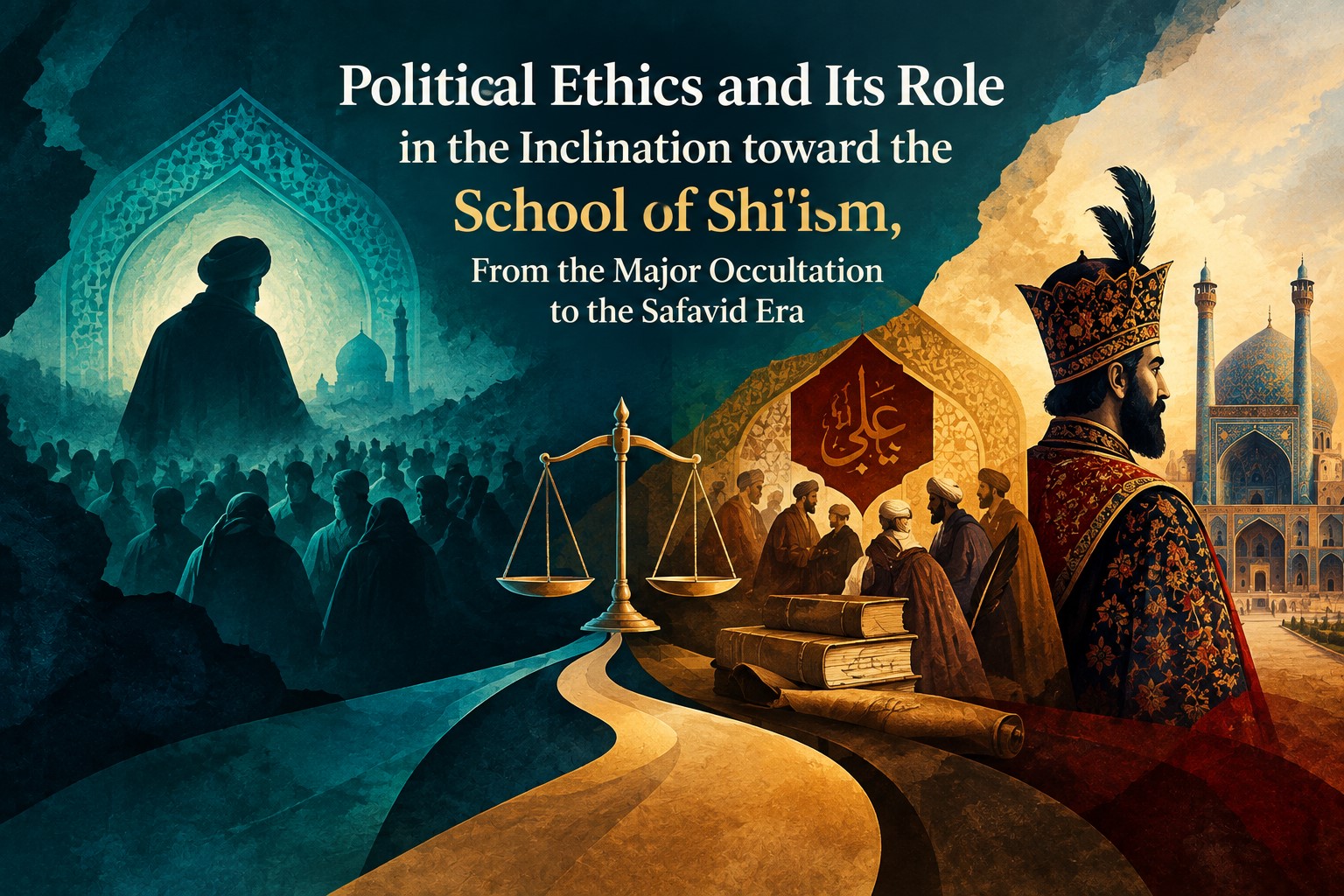
Political Ethics and Its Role in the Inclination toward the School of shiism From the Major Occultation to the Safavid Era

Political Ethics and Its Role in the Inclination toward the School of shiism From the Major Occultation to the Safavid Era

Volume 2, Issue 5, September and October 2026, Pages 406-415

https://doi.org/10.5281/zenodo.22955917

Shirin Aramesh

Abstract Ethics and its components hold particular importance in the political arena. These components, in the political arena, possess great potential as a foundational factor for the expansion of religion and the dissemination of the school. Most Shia politicians and statesmen, by applying ethical principles in politics, were able to take the correct path in politics and be influential in society''s inclination toward the Shia religion. The present study, with an "analytical-descriptive" approach and based on the "documentary studies" method, seeks to answer the question: What capacities do ethical components in the political arena possess for the dissemination of and inclination toward the teachings of the Ahl al-Bayt (peace be upon them)? Studies show that the observance of ethics in politics, such as affection and populism, tolerance, justice-seeking, simple living, not distancing oneself from the people, rationalism, and legalism, was influential in people''s inclination toward Shi''ism. This study aims to express the ethics of Shia statesmen and, by examining them, show what ethical principles these politicians and rulers were able to adopt in politics in such complex conditions to advance the expansion of Shi''ism. Obviously, examining those ethical principles whose adherence by Shia politicians and statesmen in the political arena caused people''s inclination and positive attitude toward this Shia religion and the export of this nascent culture in this period of time can familiarize us more with the role of ethics in the dissemination of religion and the school of society.

The jurisprudential ruling concerning the offering of gifts to judges in Islamic law

The jurisprudential ruling concerning the offering of gifts to judges in Islamic law

Volume 1, Issue 10, October 2025, Pages 634-639

https://doi.org/10.5281/zenodo.17747603

Shirin Aramesh

Abstract The permissibility of a judge’s acceptance of gifts from litigating parties or from others is among the significant issues long debated within Islamic jurisprudence. Given the unanimous consensus among jurists regarding the prohibition of bribery, there is no dispute that a judge’s acceptance of bribes is categorically forbidden. Consequently, in the discussion of a judge’s acceptance of gifts whether from litigants or even from individuals with no pending dispute before the judge it is often presumed that any gift offered to a judge must necessarily be a bribe and cannot be motivated by any other legitimate intention. The majority of jurists have categorically ruled that it is impermissible for a judge to receive such gifts. Their principal argument is that a judge’s gift effectively constitutes a form of bribery and must therefore fall under the same prohibition. In contrast, some jurists distinguish, at the level of subject and definition, between bribery and gifting, and consequently deem the judge’s acceptance of gifts permissible. The central question raised in this article is whether the prohibition on bribery extends to gifts as well. A descriptive-analytical examination of juristic opinions indicates that a gift is not inherently equivalent to a bribe; however, certain types of gifts may, under specific circumstances, constitute bribery and thus fall under its legal ruling of prohibition.