Keywords = State Responsibility
Number of Articles: 2
Legal Dimensions of the Prohibition of Attacks on Infrastructure under International Law: The 2026 US-Israel Strikes on Irans Critical Infrastructure and Legal Avenues for Litigation in International Courts

Legal Dimensions of the Prohibition of Attacks on Infrastructure under International Law: The 2026 US-Israel Strikes on Iran's Critical Infrastructure and Legal Avenues for Litigation in International Courts

Volume 2, Issue 4, July and August 2026, Pages 295-309

https://doi.org/10.5281/zenodo.22129202

Mehdi Nematolahi

Abstract Attacks on critical infrastructure, whether kinetic or cyber, constitute one of the most pressing challenges in contemporary international law. The 2026 joint military strikes by the United States and Israel against Iran's nuclear facilities, energy infrastructure, bridges, and transportation networks, combined with concurrent cyber operations targeting communication systems, have reignited debate over the legal framework governing such attacks. This article examines the legal dimensions of the prohibition on infrastructure attacks under international law, analyzing the US-Israel strikes as a case study and exploring available legal avenues for Iran to seek recourse before international judicial bodies. Using a descriptive-analytical methodology grounded in treaty interpretation, customary international law analysis, and judicial precedent, this research finds that while international humanitarian law (IHL) provides a robust framework through the principles of distinction, proportionality, and precaution, the concept of "dual-use" objects—objects with both civilian and military applications—creates significant interpretive ambiguity . Despite this ambiguity, Article 56 of Additional Protocol I explicitly protects nuclear power plants from attack where such attacks may cause dangerous force release, and the International Criminal Court (ICC) has established precedent by issuing arrest warrants for attacks on Ukrainian critical infrastructure. The research identifies four principal legal avenues: proceedings before the International Court of Justice (ICJ), prosecution before the ICC, arbitration through bilateral dispute resolution mechanisms, and domestic litigation. However, significant obstacles persist, including the United States' withdrawal from the 1955 Treaty of Amity with Iran, non-membership in the Rome Statute, attribution challenges for cyber operations, and evidentiary difficulties. The article concludes that while international law prohibits attacks on critical infrastructure, enforcement mechanisms remain inadequate, and the most effective long-term strategy involves strengthening multilateral cooperation and developing a dedicated convention on critical infrastructure protection.
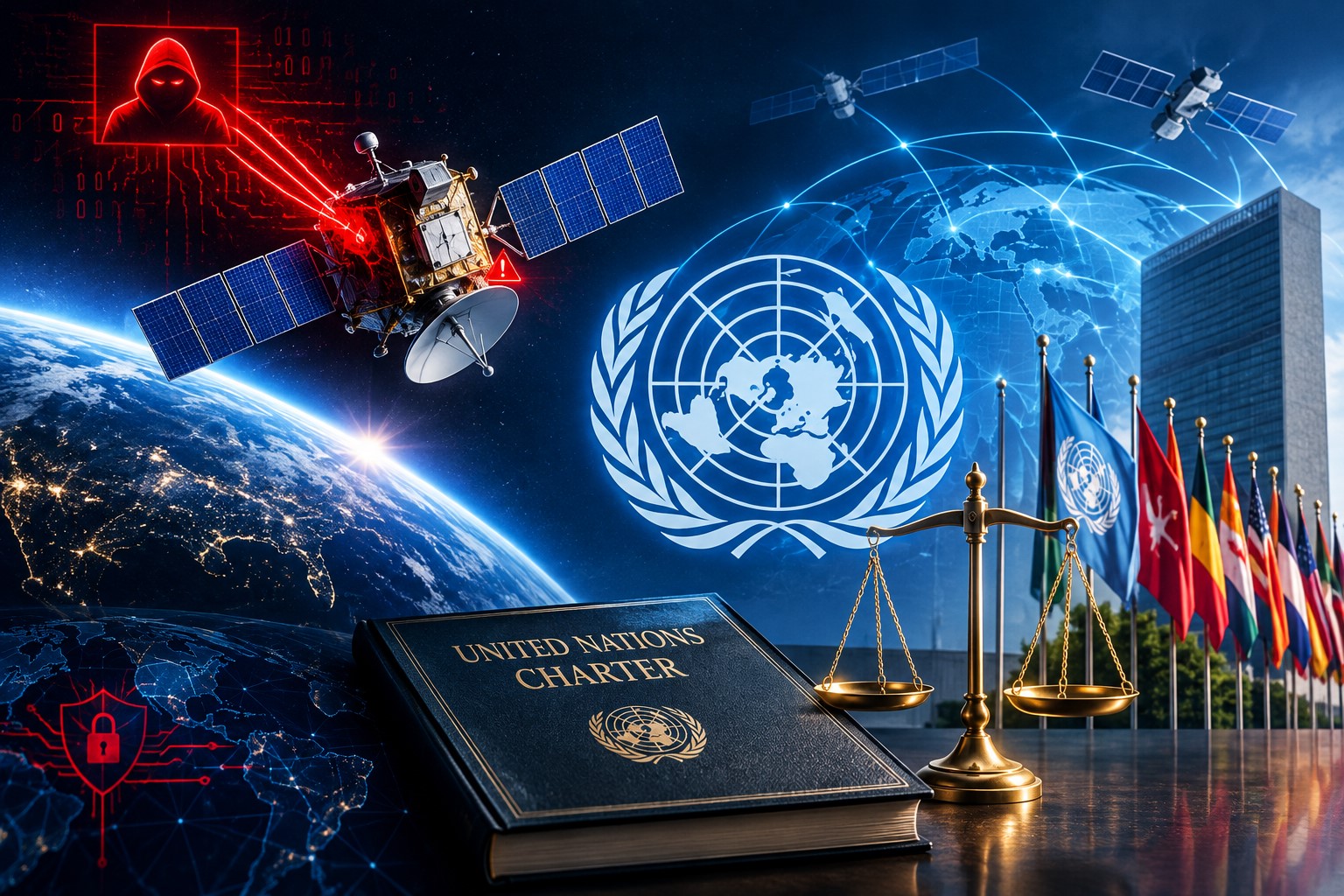
International Responsibility of States for Cyberattacks against Peaceful Space Facilities in Light of the United Nations Charter

International Responsibility of States for Cyberattacks against Peaceful Space Facilities in Light of the United Nations Charter

Volume 2, Issue 4, July and August 2026, Pages 368-379

https://doi.org/10.5281/zenodo.22954827

Hassan Bagheri, Anita Yousefi

Abstract Peaceful space facilities constitute an interdependent terrestrial-orbital infrastructure: satellites, ground stations, mission-control networks, user terminals, inter-satellite links, and software-dependent services. A malicious cyber operation directed at any one of these components may disrupt essential civilian functions far beyond the immediate target. Yet a damaging cyber incident does not itself establish an internationally wrongful act of a state, and an internationally wrongful act does not necessarily constitute a prohibited use of force or an armed attack. This article develops a sequential doctrinal framework for evaluating state responsibility for cyber operations against peaceful space facilities under the United Nations Charter, the 1967 Outer Space Treaty, and the law of state responsibility. Its method is qualitative legal analysis of primary instruments, current United Nations materials and peer-reviewed scholarship published principally in 2024–2026, supplemented by carefully labelled hypothetical scenarios. It distinguishes technical attribution, legal attribution, the content and breach of primary obligations, injury and reparation, and the independent conditions for lawful responses. It argues that Article III of the Outer Space Treaty confirms the applicability of the Charter in the space domain, whereas Articles VI–IX add distinctive but non-identical obligations concerning national space activities, launch-related liability, jurisdiction and control, and due regard. These rules should not be collapsed into a blanket presumption that a state is responsible for every cyberattack by a private actor connected to its territory. An effects-sensitive analysis can identify conduct potentially falling under Article 2(4), while the more demanding armed-attack inquiry governing Article 51 requires a separate assessment of scale, effects, necessity and proportionality. The proposed evidentiary and institutional approach prioritizes timely incident preservation, reasoned legal attribution, consultations and reversible non-forcible measures. It addresses the legal uncertainty surrounding non-destructive interference, due diligence and the reach of the specialized space-liability regime without treating contested interpretations as settled law.