Keywords = Digital Transformation
Number of Articles: 7
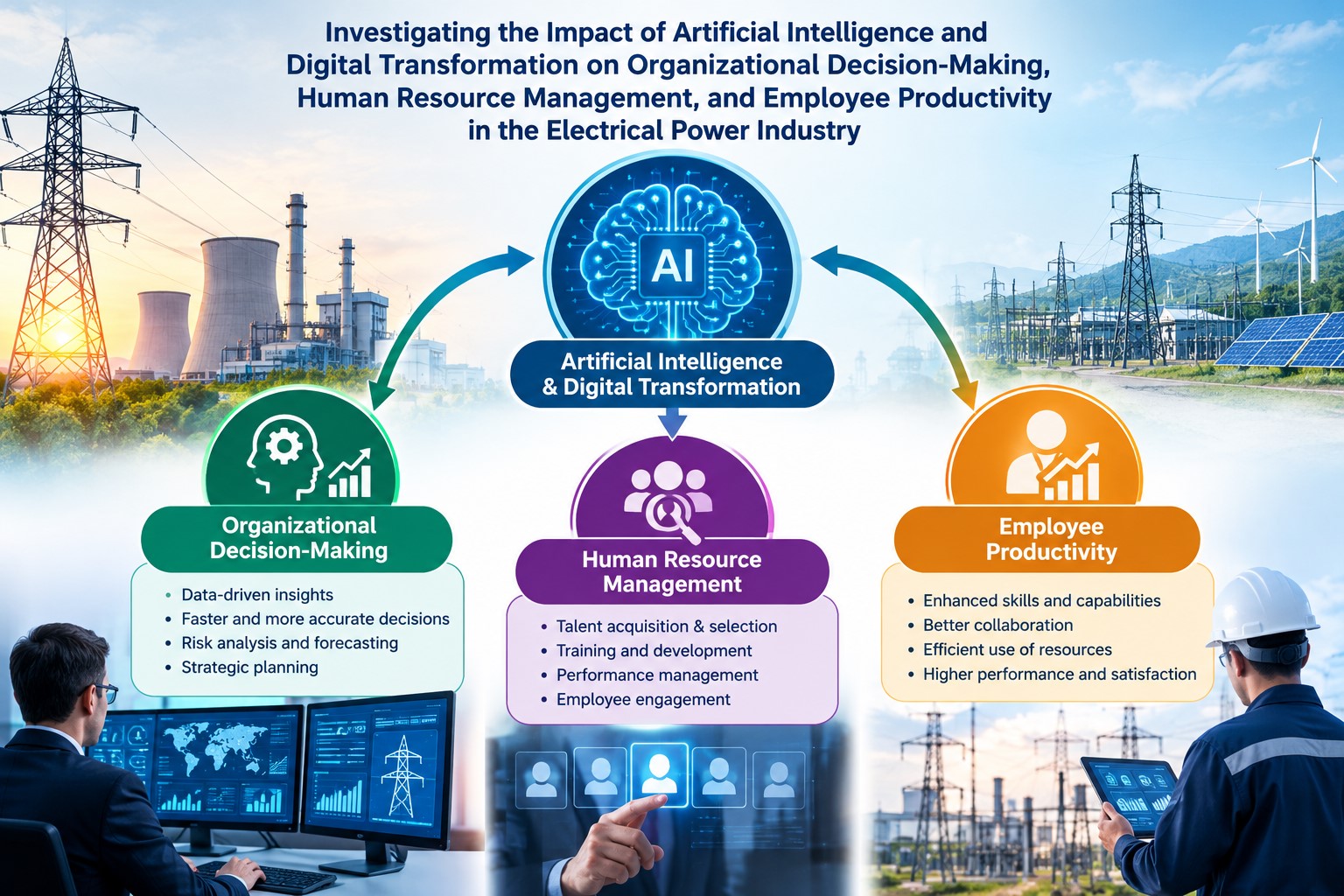
Investigating the Impact of Artificial Intelligence and Digital Transformation on Organizational Decision-Making, Human Resource Management, and Employee Productivity in the Electrical Power Industry

Investigating the Impact of Artificial Intelligence and Digital Transformation on Organizational Decision-Making, Human Resource Management, and Employee Productivity in the Electrical Power Industry

Volume 2, Issue 5, September and October 2026, Pages 472-497

https://doi.org/10.5281/zenodo.23841348

Majidreza Shishehbori

Abstract Background: Electrical power organizations are adopting artificial intelligence (AI), digital twins, advanced analytics, and workflow automation while facing aging infrastructure, changing load patterns, scarce specialist labor, and strict reliability obligations. Objective: This article investigates how AI-enabled digital transformation relates to organizational decision-making, human resource management (HRM), and employee productivity in electricity generation, transmission, distribution, and utility support functions. Methods: An integrative, structured narrative review of identifiable 2024–2026 peer-reviewed studies and reports from recognized research and standards organizations was undertaken. A cross-domain evidence matrix aligned operational use cases with organizational mechanisms, workforce outcomes, and assurance requirements. No primary interviews, experiments, or utility microdata were collected; thus no causal effect estimates are claimed. Results: The evidence supports a contingent model in which improved data availability and predictive capability can accelerate routine decisions, prioritize asset work, and support forecasting, whereas gains in human productivity depend on role redesign, training, trust, interoperability, and oversight. Benefits differ materially between office-based knowledge work and physically performed grid tasks. Algorithmic HRM creates opportunities for workforce planning and skill development but can also magnify bias, surveillance, opacity, and stress. Conclusion: Digital transformation is better understood as a jointly technical and organizational capability than as software deployment. A staged, human-accountable governance architecture and a multidimensional evaluation scorecard are proposed for future empirical testing.

Digital Transformation Strategies and Artificial Intelligence Implementation in Organizational Processes with a Change Management Approach

Digital Transformation Strategies and Artificial Intelligence Implementation in Organizational Processes with a Change Management Approach

Volume 2, Issue 4, July and August 2026, Pages 316-328

https://doi.org/10.5281/zenodo.21955918

Babak Paknahal, Aliasghar Ebrahimzadeh Esfahani, Poroshat Paknahal

Abstract Digital transformation has evolved from a technology-oriented initiative into a comprehensive organizational transformation that affects strategy, structure, processes, capabilities, culture, and value creation. At the same time, artificial intelligence (AI) has emerged as a central technological driver capable of redesigning organizational processes, supporting decision-making, automating repetitive activities, and enabling new forms of human–technology collaboration. However, the organizational value of AI not achieved through technological implementation alone. Successful implementation requires strategic alignment, organizational readiness, employee participation, leadership commitment, appropriate governance, and systematic change management. This study investigates the relationship between digital transformation strategies, AI implementation, organizational process transformation, and change management through a structured review and synthesis of the relevant literature. The analysis integrates perspectives from digital transformation, dynamic capabilities, technology adoption, organizational change, and human–AI collaboration. The findings indicate that successful AI-enabled transformation depends on four interconnected dimensions: strategic alignment and digital capabilities, process redesign and technological integration, human-centered change management, and governance and continuous organizational learning. The evidence further suggests that organizations achieve greater transformation value when AI is implemented as part of redesigned organizational processes rather than as an isolated technological tool. Leadership communication, employee training, participation, trust, and reinforcement mechanisms appear particularly important for reducing resistance and supporting sustainable adoption. The study proposes an integrated framework in which digital strategy establishes direction, AI provides technological capabilities, process redesign converts these capabilities into operational value, and change management facilitates organizational adoption and institutionalization. The results contribute to the literature by connecting technological transformation with the human and organizational mechanisms required for sustainable AI-enabled transformation.

Digital Transformation and Human Investment: The Role of Education, Culture of Change, and the Relationship of ROI to Human Capital

Digital Transformation and Human Investment: The Role of Education, Culture of Change, and the Relationship of ROI to Human Capital

Volume 1, Issue 9, September 2025, Pages 542-551

https://doi.org/10.5281/zenodo.17403517

FatemehYas Salari Pashaghi, Naser Ghayem

Abstract Digital transformation has emerged as a critical driver of organizational competitiveness in today’s dynamic and technology-driven environment. While much of the discourse emphasizes the importance of advanced technologies such as artificial intelligence, cloud computing, and data analytics, the true enabler of sustainable transformation lies in human investment. This article explores the interconnected roles of education, culture of change, and human capital in ensuring the long-term success of digital transformation initiatives. Education represents the cornerstone of this process, as it equips individuals with digital literacy, technical competencies, and adaptive skills necessary to navigate continuous disruptions. Reskilling and upskilling initiatives not only address the skills gap but, also empower employees to innovate and contribute to organizational growth. Equally important is cultivating a culture of change within organizations. Transformation requires more than new tools it demands an organizational mindset that embraces innovation, agility, collaboration, and tolerance for experimentation.A supportive culture fosters engagement, motivation, and resilience among employees, ensuring that digital strategies are implemented effectively. Furthermore, the relationship between return on investment (ROI) and human capital highlights the need to rethink traditional performance measures. Rather than limiting ROI to short-term financial metrics, organizations should adopt human-centric approaches that evaluate productivity, innovation, employee satisfaction, and long-term adaptability. Human capital development thus becomes both a strategic investment and a source of sustainable competitive advantage. By integrating education, cultural adaptability, and human capital ROI into a unified strategy, organizations can move beyond surface-level technological adoption to achieve holistic and enduring digital transformation. This human-centered perspective underscores that while technology provides the tools, it is people who ultimately drive meaningful change.

Analyzing the role of new technologies in the development of entrepreneurial businesses and innovation management in the field of startups

Analyzing the role of new technologies in the development of entrepreneurial businesses and innovation management in the field of startups

Volume 1, Issue 6, June 2025, Pages 389-405

https://doi.org/10.5281/zenodo.17157807

Saad Moarefi, Khalil Janami

Abstract Emerging technologies have become the cornerstone of entrepreneurial transformation and the driving force behind the development of innovative startups. As the digital economy expands, startups increasingly rely on advanced technological tools—such as artificial intelligence (AI), blockchain, Internet of Things (IoT), cloud computing, and big data analytics—to create competitive advantages, scale operations, and enhance market adaptability. This paper explores the critical role of emerging technologies in entrepreneurial business development and the management of innovation in startups. Drawing on theoretical frameworks in innovation management, digital transformation, and entrepreneurial ecosystems, the study investigates how new technologies empower startups to achieve efficiency, differentiation, and resilience in rapidly changing markets. It highlights both opportunities and challenges, including regulatory barriers, cybersecurity threats, resource limitations, and the ethical dimensions of technology adoption. Through a synthesis of global case studies, the article demonstrates how startups across diverse regions leverage technological advancements to disrupt industries, attract venture capital, and foster sustainable growth. The findings underscore the necessity of integrating innovation management strategies with emerging technologies to enhance entrepreneurial success, shape dynamic ecosystems, and ensure long-term value creation. Ultimately, this study contributes to academic debates and practical insights for entrepreneurs, policymakers, and investors aiming to harness technology for sustainable entrepreneurial growth.

Digital Transformation and Sustainable Business Practices for SMEs in the Context of Globalization

Digital Transformation and Sustainable Business Practices for SMEs in the Context of Globalization

Volume 1, Issue 6, June 2025, Pages 406-414

https://doi.org/zenodo.org/ajmhss.2025.548056.1032

Seyyedeh Zahra Naseri

Abstract In the context of globalization, Small and Medium Enterprises (SMEs) encounter unprecedented challenges and opportunities that demand both digital innovation and sustainable business strategies. Digital transformation, which involves the adoption of advanced technologies such as cloud computing, artificial intelligence, blockchain, and big data, enables SMEs to enhance efficiency, improve decision-making, and expand access to international markets. At the same time, sustainability has become a critical business imperative, as stakeholders increasingly expect companies to align their practices with environmental, social, and governance (ESG) standards. This paper explores the intersection between digital transformation and sustainable practices, highlighting how globalization accelerates both trends and creates a synergistic relationship. On one side, digital technologies facilitate sustainable practices through resource optimization, supply chain transparency, and reduction of carbon footprints. On the other, sustainability initiatives enhance brand reputation and provide SMEs with a competitive edge in globalized markets. Despite these benefits, SMEs face significant barriers including limited financial resources, skills shortages, and regulatory complexity. By analyzing existing literature and real-world case examples, this study argues that SMEs must adopt an integrated strategy where digital transformation supports sustainability objectives, ensuring long-term competitiveness and resilience. Moreover, global cooperation, policy support, and innovation ecosystems are essential to enable SMEs to thrive in this transformative era.

The Evolution of Contract Law: Principles, Challenges, and Future Trends

The Evolution of Contract Law: Principles, Challenges, and Future Trends

Volume 1, Issue 5, May 2025, Pages 305-315

https://doi.org/zenodo.org/records/16905533

Mohammadmahdi Hemmatnezhad Farrokhi

Abstract Contract law, as one of the most fundamental branches of legal systems, has evolved significantly over centuries to adapt to changing economic, social, and technological contexts. Its historical development—from Roman law’s emphasis on ritualistic formalities, to the medieval lex mercatoria, and later the codifications of civil law and the precedent-driven common law—highlights the dynamic interplay between law and society. Core principles such as freedom of contract, pacta sunt servanda (agreements must be kept), good faith, consideration, and legality have remained central, though their application has been continually reshaped by shifting social needs and regulatory frameworks. In modern contexts, contract law faces profound challenges. Globalization has expanded cross-border transactions, necessitating harmonization efforts through international conventions such as the CISG. Meanwhile, consumer protection has become increasingly important in addressing power imbalances and ensuring fairness in contractual relationships. The digital revolution has further transformed contract formation, with e-contracts, clickwrap agreements, and electronic signatures raising new legal and ethical issues. Emerging technologies such as blockchain and smart contracts present both opportunities for efficiency and challenges related to enforceability, remedies, and accountability. Looking forward, contract law is expected to undergo significant transformation in response to rapid technological advancement, global harmonization efforts, and the growing importance of sustainability and social responsibility. The integration of artificial intelligence into contract drafting, negotiation, and enforcement will further reshape traditional practices, while simultaneously raising questions of liability, transparency, and fairness.

Agile Implementation in Digital Transformation Projects of Public Sector Organizations

Agile Implementation in Digital Transformation Projects of Public Sector Organizations

Volume 2, Issue 1, January and February 2025, Pages 93-104

https://doi.org/10.5281/zenodo.20615604

Mahdi Noormohammad Khales, Mohammad Baradaran

Abstract The integration of agile methodologies into digital transformation initiatives within public sector organizations represents a critical yet challenging endeavor in contemporary governance. This article examines the paradoxical relationship between Agile principles—emphasizing flexibility, iterative delivery, and self-organizing teams—and the inherently bureaucratic nature of public administration, characterized by hierarchical structures, rigid procurement frameworks, and risk-averse cultures. Through a systematic synthesis of empirical studies published between 2014 and 2025, this research identifies four primary categories of implementation challenges: institutional and regulatory barriers, procurement and contractual misalignments, cultural and resistance factors, and resource and capability constraints. The findings reveal that while agile adoption can significantly enhance transparency, responsiveness, and citizen-centered service delivery, successful implementation requires fundamental adaptations rather than wholesale methodological transplantation. A multidimensional framework proposed, integrating legal-procedural adaptations, hybrid governance models, tailored procurement mechanisms, cultural transformation strategies, and iterative implementation roadmaps. This research contributes to both public administration theory and digital government practice by providing evidence-based guidance for navigating the inherent tensions between agility and accountability in democratic governance contexts.