



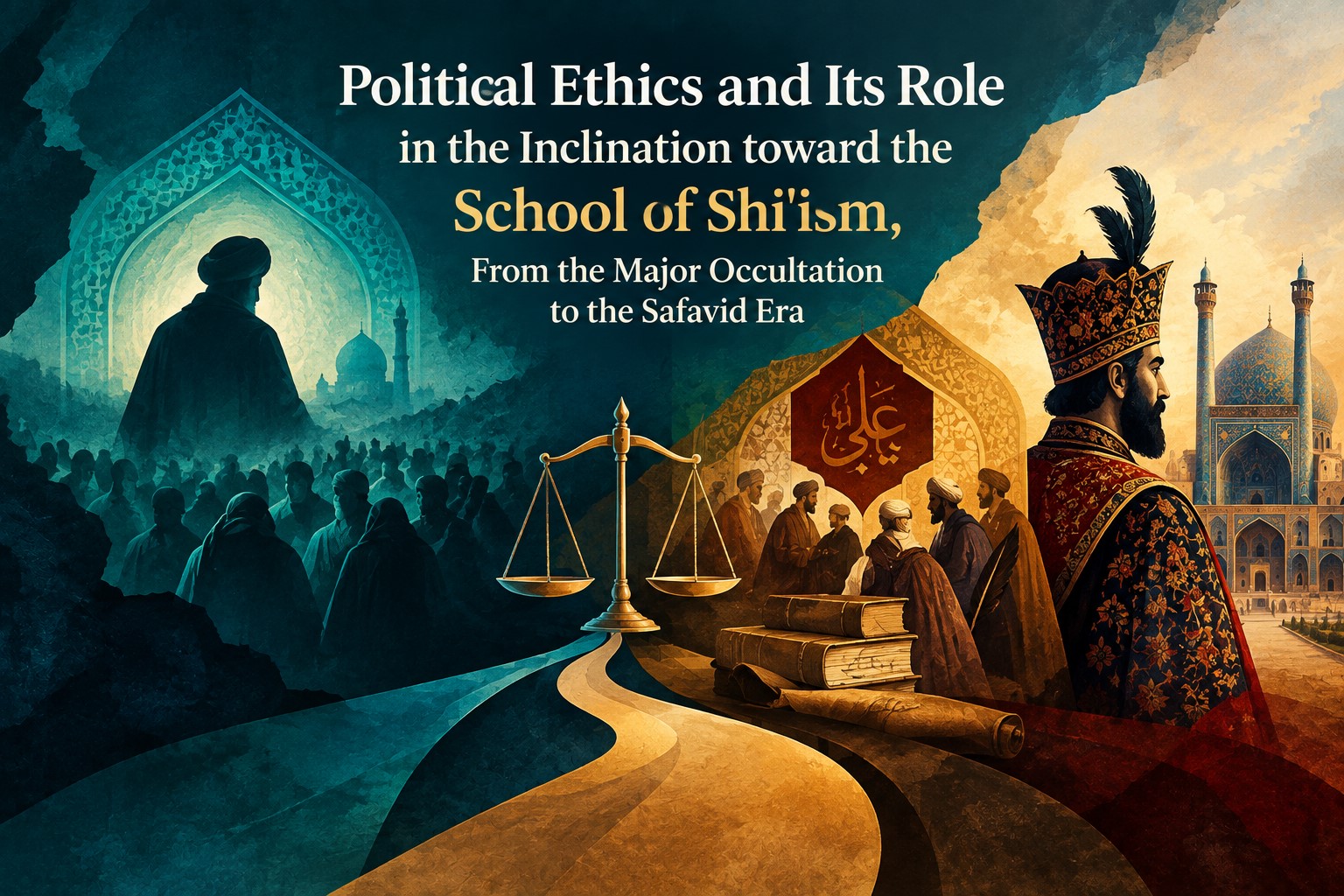
Political Ethics and Its Role in the Inclination toward the School of shiism From the Major Occultation to the Safavid Era
https://doi.org/10.5281/zenodo.22955917
Shirin Aramesh
Abstract Ethics and its components hold particular importance in the political arena. These components, in the political arena, possess great potential as a foundational factor for the expansion of religion and the dissemination of the school. Most Shia politicians and statesmen, by applying ethical principles in politics, were able to take the correct path in politics and be influential in society''s inclination toward the Shia religion. The present study, with an "analytical-descriptive" approach and based on the "documentary studies" method, seeks to answer the question: What capacities do ethical components in the political arena possess for the dissemination of and inclination toward the teachings of the Ahl al-Bayt (peace be upon them)? Studies show that the observance of ethics in politics, such as affection and populism, tolerance, justice-seeking, simple living, not distancing oneself from the people, rationalism, and legalism, was influential in people''s inclination toward Shi''ism. This study aims to express the ethics of Shia statesmen and, by examining them, show what ethical principles these politicians and rulers were able to adopt in politics in such complex conditions to advance the expansion of Shi''ism. Obviously, examining those ethical principles whose adherence by Shia politicians and statesmen in the political arena caused people''s inclination and positive attitude toward this Shia religion and the export of this nascent culture in this period of time can familiarize us more with the role of ethics in the dissemination of religion and the school of society.


