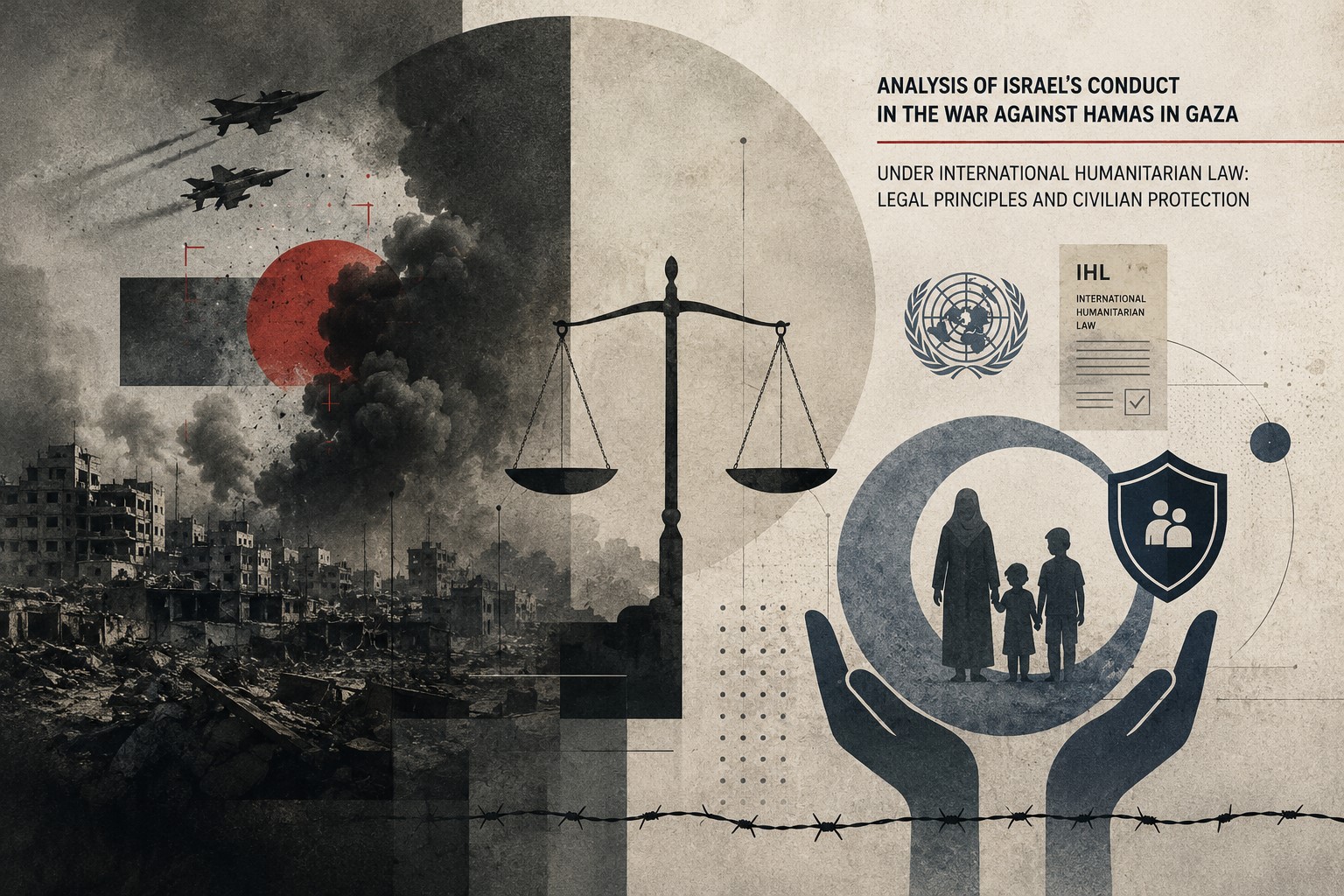
Analysis of Israel’s Conduct in the War against Hamas in Gaza under International Humanitarian Law: Legal Principles and Civilian Protection

Document Type : Original Article

Author

Department of Law, Payame Noor University (PNU), P.O. Box, 19395-3697, Tehran, Iran

10.5281/zenodo.23591702
Abstract
The recent war in Gaza, which has now passed its first anniversary, has been the longest war Israel has waged against the Palestinians and, in terms of the number of deaths and the destruction of Gaza’s entire service and healthcare infrastructure, one of the most devastating. Under the pretext of Hamas’s attack on 7 October 2023 in the south of the occupied territories, Israel launched an all-out war against a territory that has been under siege by Israeli forces for more than 20 years. This study aims to examine and analyse Israel’s conduct in the war against Hamas in light of international humanitarian law. The violations attributed to Israel are sufficiently apparent that, at first sight, reference to the principles of international law may seem unnecessary. However, given the legal and argumentative nature of each legal principle, it is preferable to identify Israel’s grave violations in Gaza through the principles established under international humanitarian law. The findings indicate that the Israeli occupying regime is liable under the principles of international humanitarian law set out in the four Geneva Conventions (1949), namely the principle of proportionality in attack, the principle of distinction between military and civilian objectives, and the principle of prohibiting unnecessary pain and suffering. During the war in Gaza, Israel has carried out attacks for which there is no military justification and which were conducted solely with the intention of harming civilians, thereby violating the principle of proportionality. Israel has deliberately disregarded the distinction between military and civilian facilities and has attacked sites such as schools and hospitals, in violation of the second principle. Finally, the siege, forced displacement, and starvation of the people of Gaza have caused extensive pain and suffering, indicating Israel’s disregard for principles such as the prohibition of unnecessary pain and suffering in warfare.

Graphical Abstract

Analysis of Israel’s Conduct in the War against Hamas in Gaza under International Humanitarian Law: Legal Principles and Civilian Protection

Keywords

Subjects

[2]    Affazul Muna, I. (2025). The principles of distinction and proportionality regarding attack on the Indonesian Hospital in Gaza by Israel Defense Force (IDF). JIL: Journal of Indonesian Law, 6(2), 186-205.   
[3]    Bagherzadeh, M. R. (2004). The universality of human rights in Islam. Ma’refat-e Falsafi [Philosophical Knowledge], 7.
[4]    Barakat, M., & Amouri, Y. (2026). The crime of starving Palestinians in the Gaza Strip: Between legal responsibility and accountability [Article in Arabic]. International Review of Law, 15(1). 
[5]    Bledsoe, R. L., & Boczek, B. A. (1987). The international law dictionary. ABC-CLIO.
[6]    Esmaeili, F., & Marjani, M. R. (2026). The integrated problem of locating, allocating, and routing transportation vehicles in the blood product supply chain during crisis conditions. Journal of Engineering Management and Soft Computing, 12(3), 1-19.   
[7]    Field, R. (2024). The international law of siege and starvation: The case of Gaza after October 7, 2023. Buffalo Human Rights Law Review, 30, 161.        
[9]    Gooran Orimi, Y., Mehrabian, A., Naderian, A., & Ayazi, S. (2026). Mathematical modeling for the distribution of relief items under uncertainty to control vehicle costs and downtime. Journal of Engineering Management and Soft Computing, 12(4), 59-82.       
[10] Haghshenas Nasrabadi, A., & Ghasemy Yaghin, R. (2025). The role of data quality and visibility in risk management and performance optimization in the downstream supply chain. Journal of Data Analytics and Intelligent Decision-Making, 1(1), 23-32.       
[11] Hector, G. A. (2010). The universality of human rights and cultural diversity. Majalleh-ye Haghighat-e Hoquqi [Legal Research Journal], 38.
[12] Human Rights Watch. (2023). Israel: White phosphorus used in Gaza, Lebanon.
[13] International Committee of the Red Cross. (2005a). Customary international humanitarian law: Rule 1, the principle of distinction between civilians and combatants.
[14] International Committee of the Red Cross. (2005b). Customary international humanitarian law: Rule 14, proportionality in attack.       
[15] International Committee of the Red Cross. (2005c). Customary international humanitarian law: Rule 140, principle of reciprocity.       
[16] International Committee of the Red Cross. (2005d). Customary international humanitarian law: Rule 53, starvation as a method of warfare.
[17] International Committee of the Red Cross. (2005e). Customary international humanitarian law: Rule 70, weapons of a nature to cause superfluous injury or unnecessary suffering.
[18] International Committee of the Red Cross. (2021). International humanitarian law and international human rights law: Similarities and differences.
[21] International Criminal Court. (1998). Rome Statute of the International Criminal Court.
[23] Jafari Langroudi, J. (1997). Moghadameh-ye omumi-ye elm-e hoquq [General introduction to legal science]. Ganj-e Danesh.
[24] Jafari Langroudi, J. (2013). Terminology of law. Ganj-e Danesh.    https://ci.nii.ac.jp/ncid/BB08173954
[25] Jahani, M., & Raji, F. (2025). Intelligent counterfeit detection through hybrid pattern mining and blockchain traceability: A drug distribution case study. Journal of Data Analytics and Intelligent Decision-Making, 1(3), 85-101.  
[27] Kasseh, A. (2006). Public international law in a divided world (M. Kalantarian, Trans.). Office of International Legal Services.
[28] Katouzian, N. (1998). Philosophy of law (Vol. 1). Enteshar.            
[29] Khanji, M. Y., Fast, L., Nimerawi, A., Smith, J., Rahman, M. E. F., Abdel-Mannan, O., Blanchet, K., Taithe, B., Read, R., Haar, R. J., Kader, Y., Green, N. C., & Gordon, N. (2025). Safeguarding healthcare workers in Gaza and throughout occupied Palestine. BMJ Global Health, 10(2), e017245.             
[30] Khoshnami, S., & Mashayekhi, E. (2026). Presenting a mathematical programming model for the allocation of relief goods in crises in the humanitarian supply chain. Journal of Engineering Management and Soft Computing, 12(3), 20-38.
[31] Lederman, Z. (2026). International humanitarian law and the immunity of hospitals in Gaza. Bioethics, 40(1), 12-20.       
[32] Mehr pour, H. (2010). Human rights in international instruments and the position of the Islamic Republic of Iran. Ettelaat Publications.
[33] Modarres, A. (2002). Natural law or the foundations of human rights (1st ed.). Nobel Publications.
[34] Mohammadi Haroniyeh, N., & Jami Pour, M. (2026). Building trust in artificial intelligence deployment: Designing a trustworthy artificial intelligence framework through a mixed method study. Journal of Data Analytics and Intelligent Decision-Making, 2(3), 212-239.
[35] Momtaz, J. (2024). International law of weapons of mass destruction (A. H. Ranjbarian, Trans.). Mizan Legal Foundation.
[36] Momtaz, J., et al. (2010). Minimum applicable humanitarian human rights rules in domestic disturbances and riots. Majalleh-ye Hoquqi-ye Dadnameh [Dadnameh Legal Journal], 4.
[37] Morejon, J. (2001). Human rights (A. Taghizadeh, Trans.). University of Tehran, Faculty of Law and Political Science.
[38] Office of the United Nations High Commissioner for Human Rights. (2008). Working with the United Nations human rights programme: A handbook for civil society. United Nations.
[40] Rafiei, S. K. (2008). International standards for conventional weapons [Master’s thesis, University of Tehran].
[41] Sachar, R. (2001). International humanitarian law with particular reference to International Criminal Court. ISIL Year Book of International Humanitarian and Refugee Law.
[42] Saed, N. (2014). Contemporary international law: Theories and practices. Khorsandi Publications.
[43] Sharifi Tarazkuhi, H. (2009). International humanitarian law. Mizan Publications.
[44] Siah Rostami, H. (2006). Collection of papers from the conference on the international Red Cross and Red Crescent Movement and international humanitarian law. Kalam Shida.
[45] Tigerstrom, B. V. (2014). Human security and international law (A. Amir-Arjomand, Trans.). Majd Publications.             
[46] United Nations Human Rights Council, Independent International Commission of Inquiry. (2024). Report of the Independent International Commission of Inquiry on the Occupied Palestinian Territory, including East Jerusalem, and Israel (A/HRC/56/26). United Nations.
[47] United Nations Office for the Coordination of Humanitarian Affairs. (2024). Hostilities in the Gaza Strip and Israel: Flash update #171. https://www.ochaopt.org/content/hostilities-
[48] Vahedi, G. A. (2017). Introduction to legal science (2nd ed.). Ganj-e Danesh Library Publications.
[49] van Steenberghe, R. (2024). The armed conflict in Gaza, and its complexity under international law: Jus ad bellum, jus in bello, and international justice. Leiden Journal of International Law, 37(4), 983-1017. 
[50] Vernor, L. (2013). Vital national interests and international law in global civil society (H. Sharifi Tarazkuhi, Trans.). Nashr Dadgostar.
[51] Wolf, R. (2025). Applying precautions in target verification with AI decision support systems. Israel Law Review, 58(2–3), 282-305.
[52] Zakerian, M. (2014). Key concepts of international human rights (3rd ed.). Mizan Legal Foundation.   
[53] Ziaei Bigdeli, M. R. (2001). Law of war: International law of armed conflicts. Allameh Tabataba’i University Publications.       
[54] Ziaei Bigdeli, M. R. (2022). Humanitarian law and human rights: A study of recent developments in international humanitarian law. Sarsam Publications.