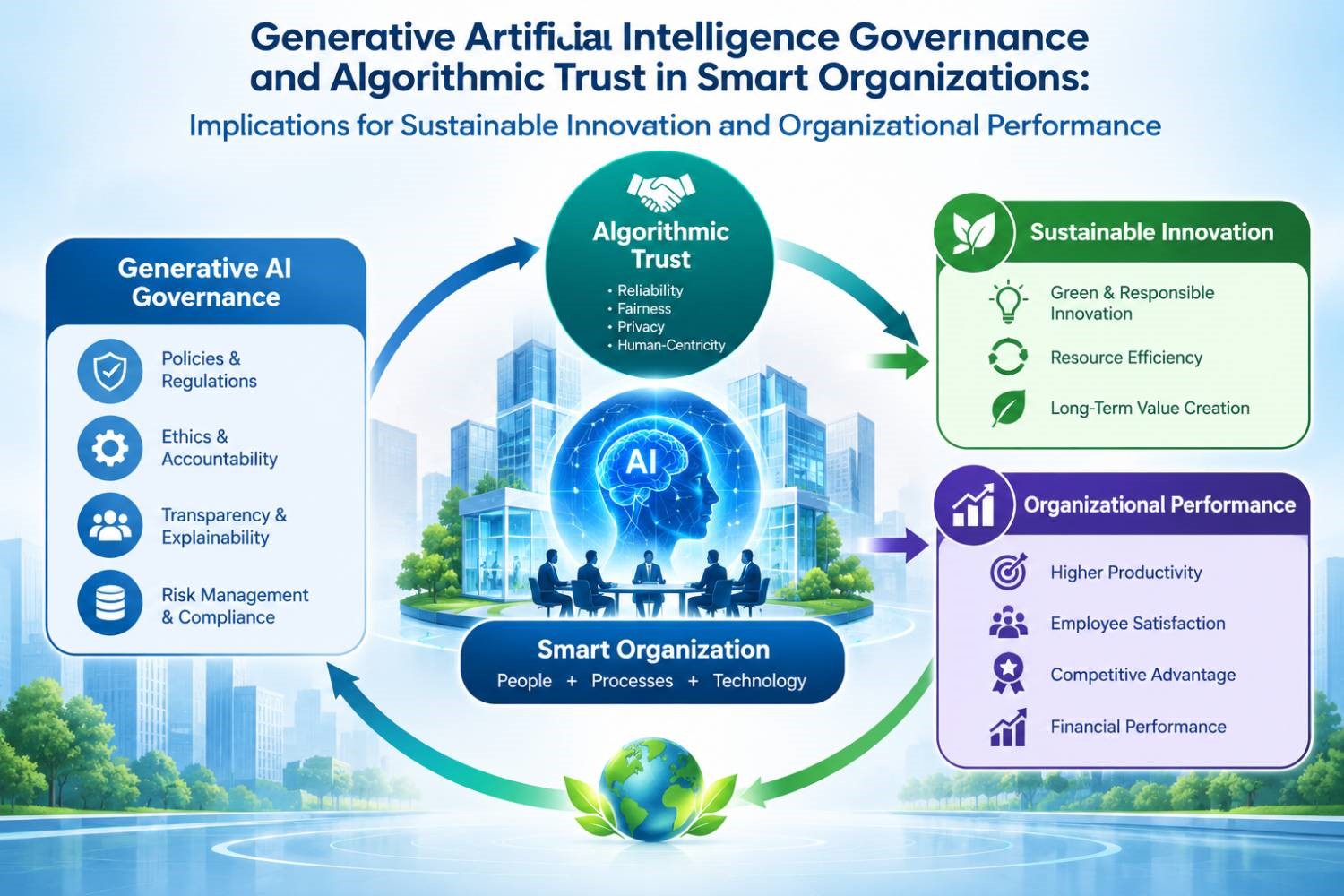
Generative Artificial Intelligence Governance and Algorithmic Trust in Smart Organizations: Implications for Sustainable Innovation and Organizational Performance

Document Type : Original Article

Authors

1 M.A. in Psychology and B.A. in Business Administration, University of Applied Science and Technology, Ilam Branch, Ilam, Iran

2 B.Sc. in Applied Chemistry, Islamic Azad University, South Tehran Branch, Tehran, Iran, CEO of Ravan Gostaran Tavan Gharb Company

3 Ph.D. in Industrial Management (Systems Management), Islamic Azad University, Sanandaj Branch, Sanandaj, Iran; Deputy CEO of Ravan Gostaran Tavan Gharb Company

10.5281/zenodo.23441177
Abstract
Purpose—Generative artificial intelligence (GenAI) is being integrated into knowledge work, organizational decision support, and sustainability-related operations, yet evidence regarding governance, algorithmic trust, and durable organizational value remains fragmented. This article develops an integrated explanation of how responsible governance can enable, rather than merely constrain, the creation of sustainable innovation and organizational performance. Design/methodology/approach—A critical, structured integrative synthesis draws on recent peer-reviewed research and authoritative policy and standards publications issued between 2023 and October 2026. Sources compared through thematic coding across governance architecture, calibrated algorithmic trust, human–AI collaboration, sustainable innovation, and organizational performance. The article proposes constructs, testable propositions, an implementation framework, and a future empirical research design; it does not claim to report original survey or experimental findings. Findings—Governance quality theorized to improve organizational outcomes through calibrated trust and responsible human–AI practices. The effects are contingent on decision criticality, employee AI literacy, accountability arrangements, institutional pressure, and the environmental costs of computation. Trust appropriately calibrated to system reliability rather than maximized. Practical implications—Organizations should combine documented use-case inventories, risk-tiered oversight, evaluation, traceability, worker participation, and multidimensional scorecards. Originality/value—the framework connects governance mechanisms and behavioral trust calibration to an explicitly triple-bottom-line account of innovation and performance, while separating established empirical evidence from propositions requiring testing.

Graphical Abstract

Generative Artificial Intelligence Governance and Algorithmic Trust in Smart Organizations: Implications for Sustainable Innovation and Organizational Performance

Keywords

Subjects

[2]    Autio, C., Schwartz, R., Dunietz, J., Jain, S., Stanley, M., Tabassi, E., Hall, P., & Roberts, K. (2024). Artificial Intelligence Risk Management Framework: Generative Artificial Intelligence Profile (NIST AI 600-1). National Institute of Standards and Technology.
[3]    Bag, S., Srivastava, G., Routray, S., & Chiarini, A. (2026). Generative AI, ESG sensemaking, and environmental performance: An OIPT perspective. Business Strategy and the Environment, 35(5), 7196-7217.      
[4]    Batool, A., Zowghi, D., & Bano, M. (2025). AI governance: A systematic literature review. AI and Ethics, 5, 3265-3279.
[5]    Brynjolfsson, E., Li, D., & Raymond, L. (2025). Generative AI at work. The Quarterly Journal of Economics, 140(2), 889-942.       
[6]    Burton, J. W., et al. (2024). How large language models can reshape collective intelligence. Nature Human Behaviour.   
[8]    Doshi, A. R., & Hauser, O. P. (2024). Generative AI enhances individual creativity but reduces the collective diversity of novel content. Science Advances, 10(28), eadn5290.
[9]    Feng, B., Chen, X., & Tang, H. (2026). AI-driven green governance: Assessing the impact of artificial intelligence on corporate sustainability performance. Journal of Innovation & Knowledge, 11, 100869.             
[11] Lee, B. C., & Chung, J. (2024). An empirical investigation of the impact of ChatGPT on creativity. Nature Human Behaviour, 8, 1906-1914.
[13] Luengo Vera, C., Bhimani, A., Gómez Gandía, J. A., & de Lucas, A. (2026). Generative AI and the algorithmic workplace: A bibliometric and conceptual analysis of its impact on organizational decision-making and work design. Journal of Open Innovation: Technology, Market, and Complexity, 12(1), 100710.
[14] Meincke, L., Nave, G., & Triesch, C. (2025). ChatGPT decreases idea diversity in brainstorming. Nature Human Behaviour, 9, 1107-1109.
[15] Organization for Economic Co-operation and Development. (2024). Explanatory memorandum on the updated OECD definition of an AI system (OECD AI Papers No. 8).
[16] Prasad, K. D. V., & De, T. (2024). Generative AI as a catalyst for HRM practices: Mediating effects of trust. Humanities and Social Sciences Communications, 11, Article 1362.           
[17] Schilke, O., & Reimann, M. (2025). The transparency dilemma: How AI disclosure erodes trust. Organizational Behavior and Human Decision Processes, 188, 104405.
[18] Stanford Institute for Human-Centered Artificial Intelligence. (2026). The AI Index Report 2026: Economy. Stanford University.
[19] Sullivan, V., & Weger, K. (2025). Transparency and explainability in AI-assisted decision making: Effects on trust, perceived reliability, confidence, and ease of understanding. Proceedings of the Human Factors and Ergonomics Society Annual Meeting, 69(1).
[20] Vaccaro, M., Almaatouq, A., & Malone, T. (2024). When combinations of humans and AI are useful: A systematic review and meta-analysis. Nature Human Behaviour, 8, 2293-2303.
[21] World Economic Forum. (2025). The Future of Jobs Report 2025. 
[22]Zaheer, A., Subramaniam, Y., Zayed, N. M., Bipasha, M. S., & Alrawi, W. K. (2026). Generative AI utilization and employee productivity through digital skills with the moderating role of AI trust. Discover Sustainability.