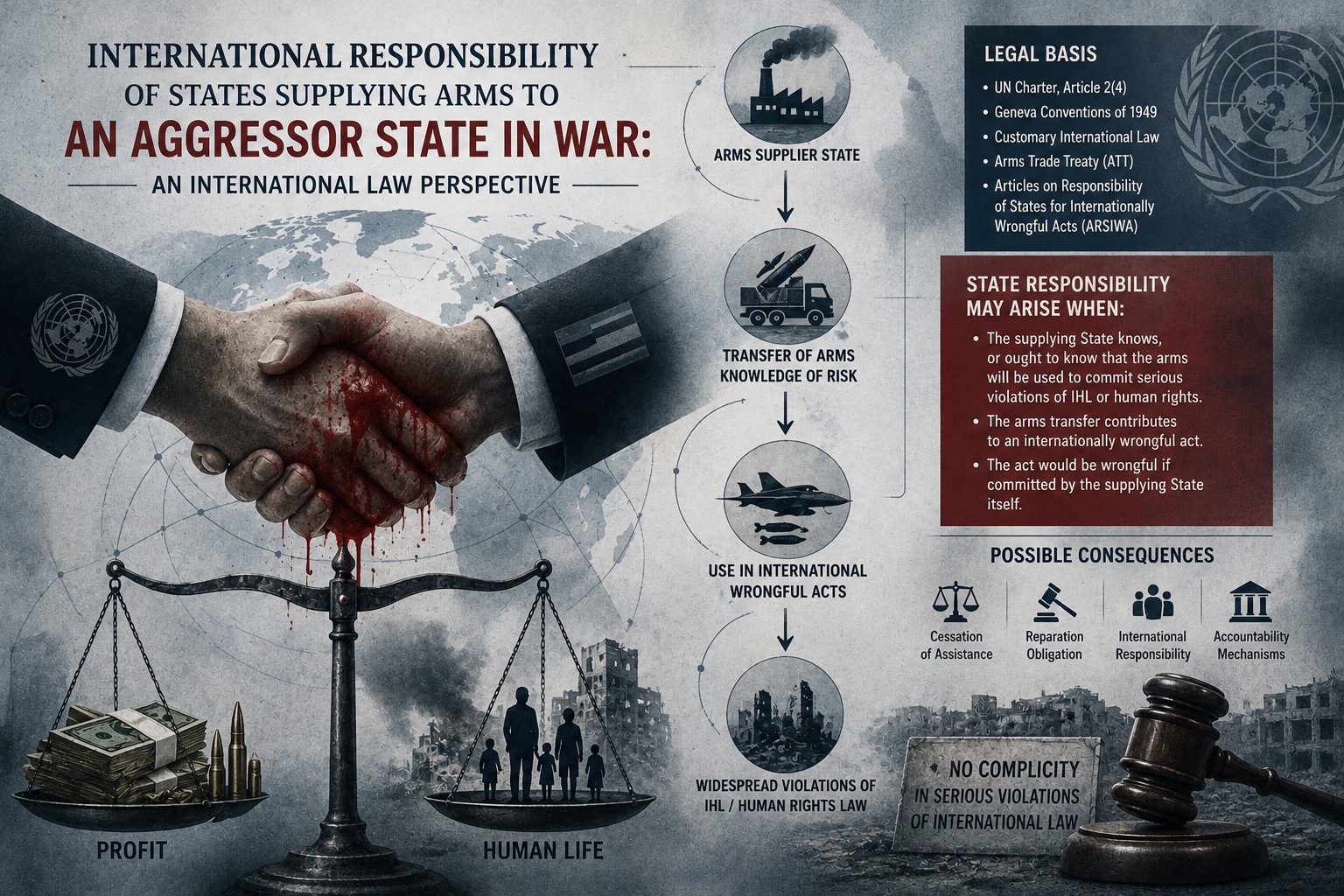
International Responsibility of States Supplying Arms to an Aggressor State in War: An International Law Perspective

Document Type : Original Article

Author

Department of Law, Payame Noor University (PNU), P.O. Box, 19395-3697, Tehran, Iran

10.5281/zenodo.23591538
Abstract
A state incurs international responsibility when it commits an internationally wrongful act. Assuming that conduct consisting of an act or omission has occurred, Article 2 of the Draft Convention on the International Responsibility of States requires two elements for an international wrong to be established. First, the act or omission must be attributable to a state under international law. Second, the conduct must constitute a breach of that state’s international obligations. Together, these two conditions provide a sufficient basis for establishing international responsibility. In some cases, the respondent state may argue that its act or omission was justified, for example, on the grounds of self-defence or force majeure. Under international law, such defences or justifications are referred to as “circumstances precluding wrongfulness.” This study aims to explain the international responsibility of states that arm a country recognised as an aggressor in a war. For example, despite international agreements, the United States has supplied Israel with tactical and strategic weapons on a daily basis over the past year. Invoking the concept of self-defence, Israel has waged an extensive war against Muslim countries and has conducted this war with American weapons. Accordingly, this study examines the international responsibility of states such as the United States for international violations involving the supply of arms to aggressor states, including Israel. Two principal issues are considered. The first concerns the conduct of states such as the United States which, despite knowing that Israel uses their weapons in warfare against civilians, may be regarded as complicit in its international crimes. The second concerns the validity of the United States’ reliance on self-defence to justify arms transfers to Israel, a position that faces serious challenges under international law.

Graphical Abstract

International Responsibility of States Supplying Arms to an Aggressor State in War: An International Law Perspective

Keywords

Subjects

[1]    Abolghasemian, M., Bigdeli, H., & Shamami, N. (2024). Locating routing problem (LRP) of distribution of priority support items to ground forces in war conditions. Journal of Engineering Management and Soft Computing, 10(1), 262-292.
[2]    Ajvevski, M. (2008). Serious breaches, the Draft Articles on State Responsibility and universal jurisdiction. European Journal of Legal Studies, 2(1).
[3]    Akehurst, M. (1987). A modern introduction to international law (6th ed.). Unwin Hyman.
[5]    Arghiani, M., Rezaeenour, J., Rahnama, A., & Roozbahani, Z. (2026). A systematic review of the process mining literature in the supply chain. Journal of Engineering Management and Soft Computing, 12(3), 111-149.     
[6]    Arms Trade Treaty. (2013). United Nations Treaty Series, 3013, 269.           
[7]    Bahadori Jahromi, H. (2026). From analytics to agility: How smart contract capability and supply chain digitalization strengthen supply chain performance in financial services. Journal of Data Analytics and Intelligent Decision-Making, 2(3), 31-61. 
[8]    Bikzadeh, A. (2002). Course notes on international law. Shahid Beheshti University.
[9]    Caire case (France v. Mexico), )1929(, Reports of International Arbitral Awards, Vol. V, pp. 516-534. 
[11] Dannenbaum, T., & Dill, J. (2024). International law in Gaza: Belligerent intent and provisional measures. American Journal of International Law, 118(4), 659-683.       
[12] Ebrahim-Gol, A. R. (2011). State responsibility: Text and commentary on the International Law Commission’s Draft Articles. Shahre Danesh Institute for Legal Studies and Research.
[13] Factory at Chorzów (Germany v. Poland), Jurisdiction, Judgment No. 8, 1927, P.C.I.J. Series A, No. 9.
[14] Franck, T. M. (2003). Recourse to force: State action against threats and armed attacks. Cambridge University Press.        
[15] Haghshenas Nasrabadi, A., & Ghasemy Yaghin, R. (2025). The role of data quality and visibility in risk management and performance optimization in the downstream supply chain. Journal of Data Analytics and Intelligent Decision-Making, 1(1), 23-32. 
[17] Helmi, N. (2011). State responsibility and diplomatic protection. Mizan Publishing.
[19] International Court of Justice. (1986). Military and paramilitary activities in and against Nicaragua (Nicaragua v. United States of America), merits, judgment, I.C.J. Reports 1986, p. 14.
[21] International Court of Justice. (2024a). Application of the Convention on the Prevention and Punishment of the Crime of Genocide in the Gaza Strip (South Africa v. Israel), order of 26 January 2024.            
[22] International Court of Justice. (2024b). Alleged breaches of certain international obligations in respect of the Occupied Palestinian Territory (Nicaragua v. Germany), order of 30 April 2024.
[23] International Court of Justice. (2024c). Legal consequences arising from the policies and practices of Israel in the Occupied Palestinian Territory, including East Jerusalem, advisory opinion of 19 July 2024.
[24] International Law Commission. (2001). Draft articles on responsibility of states for internationally wrongful acts, with commentaries. Yearbook of the International Law Commission, 2001, Vol. II, Part Two.
[25] International Law Commission. (2011). Draft articles on the responsibility of international organizations, with commentaries. Yearbook of the International Law Commission, 2011, Vol. II, Part Two.     
[26] Jørgensen, N. H. B. (2014). State responsibility for aiding or assisting international crimes in the context of the Arms Trade Treaty. American Journal of International Law, 108(4), 722-749.
[27] Kalantari, K. (2004). Private criminal justice in the Iranian criminal justice system. In Criminal sciences: Essays in honor of Dr. Mohammad Ashouri. SAMT Publishing.               
[28] Katouzian, N. (2006). Introductory course on civil law. Enteshar Joint Stock Company.
[29] Khosravi, A. A. (1995). International law of self-defense. Afarineh Cultural Institute.
[30] Madani, S. J. (2009). Public international law and the principles of interstate relations (Vol. 3). Paydar Publishing.            
[31] Marjani, M. R., Habibi, M., Jabbari, M., & Aghaee, M. (2026). A hybrid approach based on data density analysis for group supplier selection problem considering multi-level risk assessment: A case study. Journal of Data Analytics and Intelligent Decision-Making, 2(3), 1-30.   
[32] Mohseni, M. (1997). General criminal law: Criminal responsibility (3rd ed.). Ganj-e Danesh Publishing.              
[33] Momtaz, J., & Ranjbaran, A. H. (2011). International humanitarian law: Non-international armed conflicts. Mizan Publishing.
[34] Moqtader, H. (2022). Public international law. Center for Political and International Studies, Ministry of Foreign Affairs.
[35] Mossalanejad, A. (2018). The Middle East security and Donald Trump’s grand strategy. Geopolitics Quarterly, 13(4).     
[36] Moynihan, H. (2018). Aiding and assisting the mental element under Article 16 of the International Law Commission’s Articles on State Responsibility. International & Comparative Law Quarterly, 67(2), 455-471.
[37] Niyakouei, S. A., & Amani, F. (2024). U.S. foreign policy toward Israel and its consequences for Iran’s national security (2020-2024). West Asia Quarterly, 2(2), 33-58.
[38] Office of the United Nations High Commissioner for Human Rights. (2024a). Arms exports to Israel must stop immediately: UN experts.         
[39] Office of the United Nations High Commissioner for Human Rights. (2024b, June 20). States and companies must end arms transfers to Israel immediately or risk responsibility for human rights violations: UN experts.
[40] Prosecutor v. Tadić, Case No. IT-94-1-A, Judgment, 15 July 1999.
[42] Roskin, M. G. (2016). Rebalancing offshore balancing. Parameters, 46(3), 79-90.      
[44] Sanaei, P. (1998). General criminal law (Vol. 1). Ganj-e Danesh Publishing.
[45] Sarmad, Z., Bazargan, A., & Hejazi, E. (2011). Research methods in behavioral sciences. Agah Publishing.
[46] Schaller, C. (2023). When aid or assistance in the use of force turns into an indirect use of force. Journal on the Use of Force and International Law, 10(2), 202-229.         
[47] Shamami, N., Vaseei, M., & Veysi, O. (2026). Data envelopment analysis (DEA) for modeling efficiency in the deployment of military units for humanitarian missions. Journal of Engineering Management and Soft Computing, 12(3), 168-180.        
[48] Shariat Bagheri, M. J. (2013). International criminal law. Jangal Publishing.
[49] Sharp, J. M. (2025). U.S. foreign aid to Israel: Overview and developments since October 7, 2023 (CRS Report RL33222). Congressional Research Service.             
[50] Sicula Elettronica S.p.A. (ELSI) (United States of America v. Italy), Judgment, I.C.J. Reports 1989, p. 15.
[51] U.S. Department of State. (2025, April 25). U.S. security cooperation with Israel.
[52] U.S. Government Accountability Office. (2001). Information on U.S. weapons deliveries to the Middle East (GAO-01-1078).       
[53] United Nations General Assembly. (1974). Definition of aggression, Resolution 3314 (XXIX).
[55] United States Diplomatic and Consular Staff in Tehran (United States of America v. Iran), Judgment, I.C.J. Reports 1980, p. 3.       
[56] Vienna Convention on the Law of Treaties. (1969). United Nations Treaty Series, 1155, 331.
[57] Wallace, R. M. M. (2022). International law (S. Q. Zamani & M. Bahramloo, Trans.). Shahre Danesh Publishing.              
[58] Williamson, M. (2003). U.S. national security challenges for the 21st century. Department of the Army.              
Zamani, S. Q. (2005). The law of international organizations: Legal personality, responsibility, and immunity. Shahre Danesh Institute for Legal Studies and Research.