Ph.D. Candidate in Information Technology Management, Islamic Azad University, Hamedan Branch, Hamedan, Iran.
10.5281/zenodo.23862344
Abstract
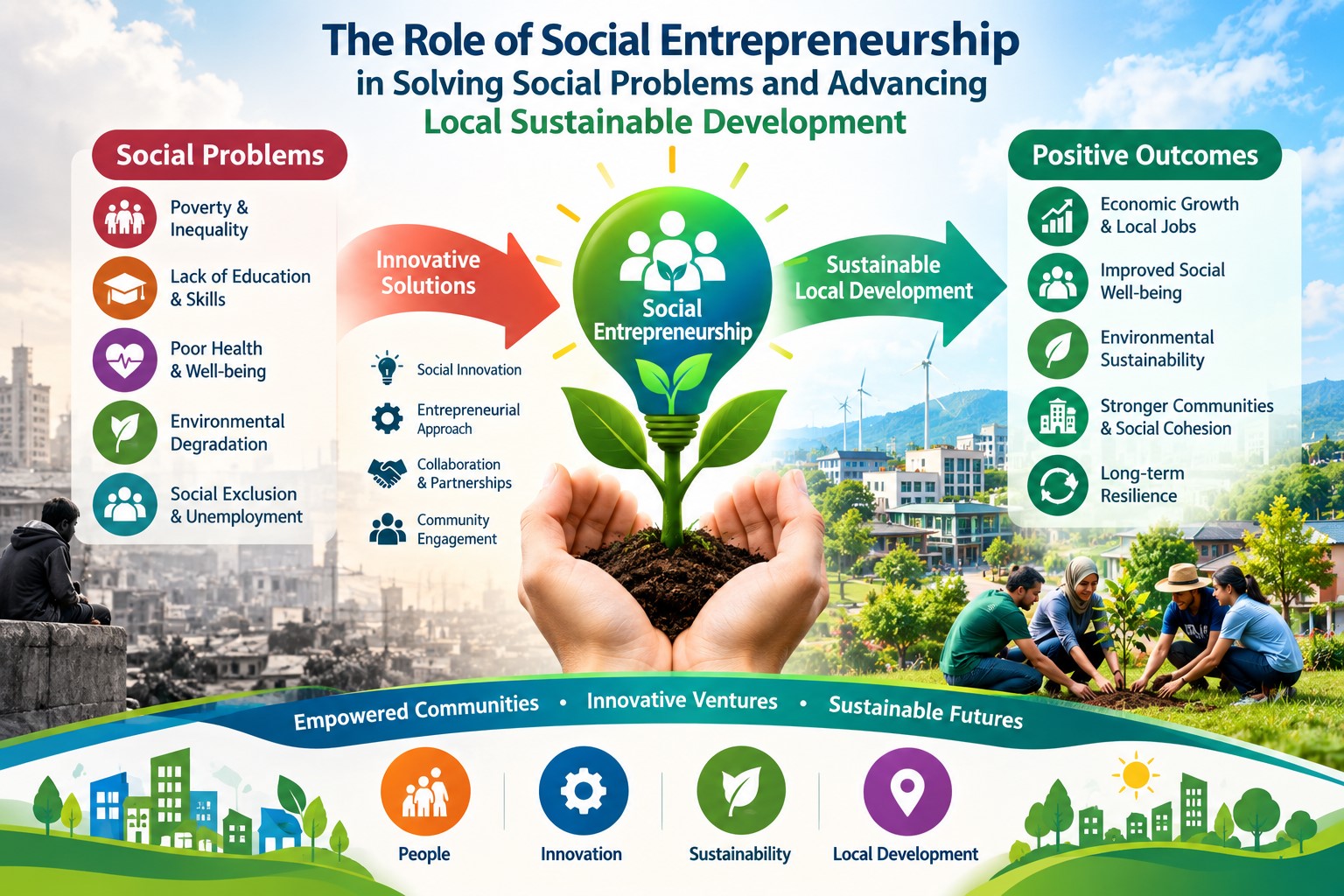
Social entrepreneurship occupies an increasingly important position between public service provision, community action and market coordination. Yet its contribution to local sustainable development is often described through success narratives rather than explicit causal mechanisms or comparable outcome measures. This integrative critical review synthesizes recent peer-reviewed research and authoritative institutional publications released during 2024–2026. Rather than presenting a new field experiment, it identifies and evaluates six mechanisms linking mission-oriented enterprise to local outcomes: access to essential services, inclusive employment, community wealth retention, social capital and participatory governance, environmental innovation, and adaptive resilience. Evidence from rural enterprise evaluation, urban township case studies, comparative organizational research, and international policy reports indicates that social ventures can address specific local market and institutional failures, especially when beneficiaries participate in design and governance. However, impact remains conditional on organizational sustainability, the distribution of benefits, external public systems, and credible counterfactual measurement. The review develops a place-based logic model, proposes a multidimensional evaluation dashboard, and specifies a practical policy sequence for municipal and regional ecosystems. It concludes that social entrepreneurship is best understood as a complement to, not a substitute for, equitable public institutions and structural reform. Future studies should prioritize longitudinal designs, geographically explicit spillovers, disaggregated distributional analysis, and more transparent impact claims.
Rahimian, A. (2026). The Role of Social Entrepreneurship in Solving Social Problems and Advancing Local Sustainable Development. Advanced Journal of Management, Humanity and Social Science, 2(5), 498–516. https://doi.org/10.5281/zenodo.23862344
MLA
Rahimian, A. "The Role of Social Entrepreneurship in Solving Social Problems and Advancing Local Sustainable Development", Advanced Journal of Management, Humanity and Social Science, 2, 5, 2026, 498–516. doi: 10.5281/zenodo.23862344
HARVARD
Rahimian, A. (2026). 'The Role of Social Entrepreneurship in Solving Social Problems and Advancing Local Sustainable Development', Advanced Journal of Management, Humanity and Social Science, 2(5), pp. 498–516. doi: 10.5281/zenodo.23862344
CHICAGO
Rahimian, A., "The Role of Social Entrepreneurship in Solving Social Problems and Advancing Local Sustainable Development." Advanced Journal of Management, Humanity and Social Science, 2 5 (2026): 498–516, doi: 10.5281/zenodo.23862344
VANCOUVER
Rahimian A. The Role of Social Entrepreneurship in Solving Social Problems and Advancing Local Sustainable Development. Advanced Journal of Management, Humanity and Social Science. 2026;2(5):498–516. doi: 10.5281/zenodo.23862344