Master of Science in Information Technology Management,Islamic Azad University, Electronic Campus,Tehran, Iran
10.5281/zenodo.23927666
Abstract
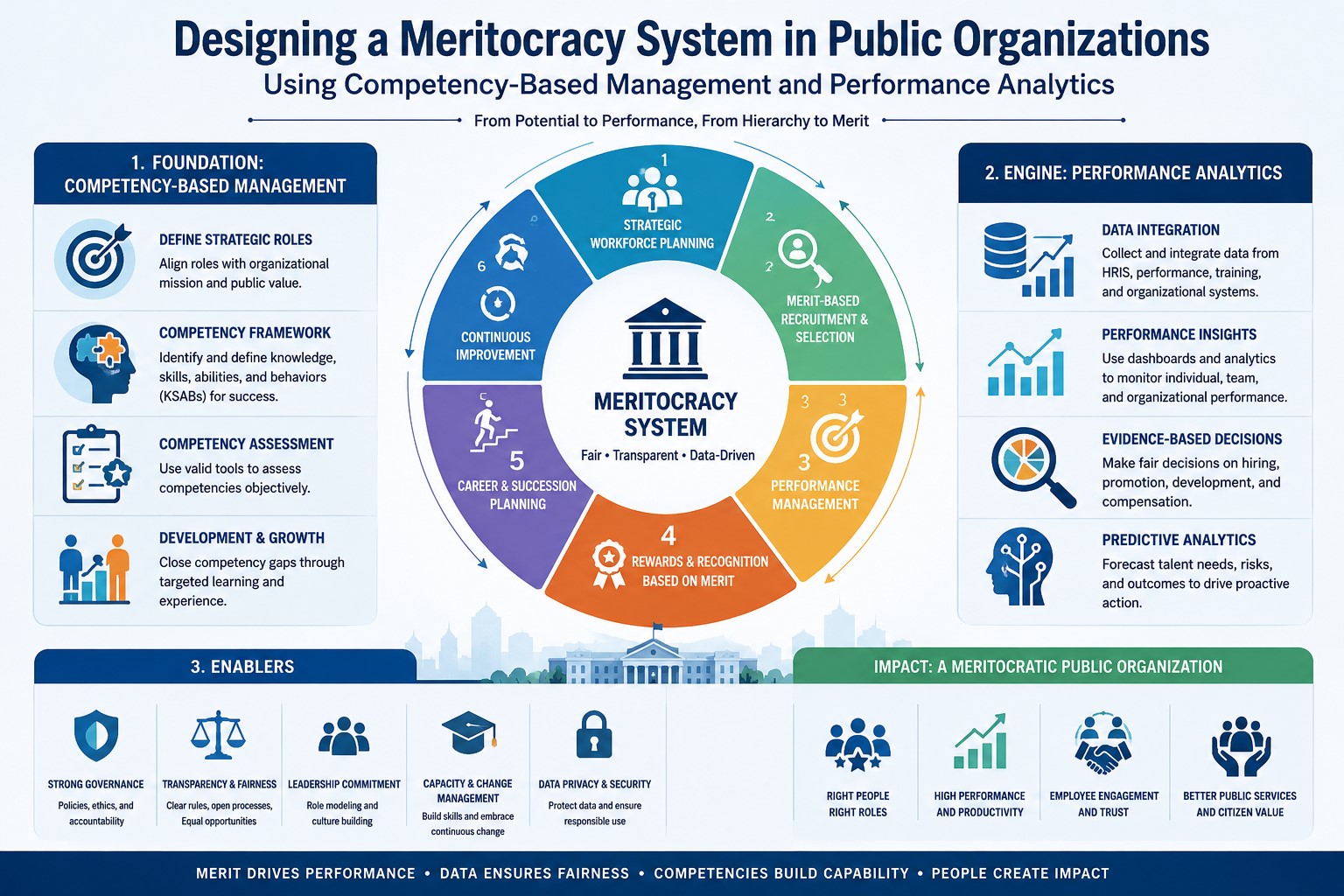
Public organizations need appointment and advancement systems that connect demonstrable capability with public service results while protecting equal opportunity and administrative impartiality. Competency frameworks often describe desirable behavior without specifying how evidence should influence employment decisions. Performance dashboards can make decisions more consistent but may also reward favorable assignments, reproduce historical disadvantage, or obscure political intervention. This article develops an integrated meritocracy system through a targeted synthesis of recent academic and institutional publications from 2024–2026 and an explicit design analysis. The study produces a role-based competency architecture, a contextualized performance measurement model, an auditable decision process, and a prospective validation protocol. Its central design principle is to distinguish eligibility, evidence sufficiency, comparative assessment, and final authorization. Integrity requirements and essential competencies operate as noncompensatory conditions; a transparent composite supports comparison only after these conditions are satisfied. A worked example with six entirely hypothetical candidates demonstrates score calculation, uncertainty bounds, sensitivity to policy weights, and the consequences of missing evidence. The example shows why a small numerical advantage cannot establish a defensible appointment when rankings reverse under plausible weighting changes. The proposed system links decisions to development opportunities, independent review, documented reasons, and monitoring of distributional effects. The results are analytical design outputs, not findings from an implemented organization or evidence of causal effectiveness. Future evaluation should examine measurement validity, procedural justice, service quality, and administrative costs through a staged pilot with independent assessment. The article contributes a practical account of meritocracy as a governed evidentiary process rather than an unqualified ranking of employees.
Salimi Beni, R. (2026). Designing a Meritocracy System in Public Organizations Using Competency-Based Management and Performance Analytics. Advanced Journal of Management, Humanity and Social Science, 2(5), 527–544. https://doi.org/10.5281/zenodo.23927666
MLA
Salimi Beni, R. "Designing a Meritocracy System in Public Organizations Using Competency-Based Management and Performance Analytics", Advanced Journal of Management, Humanity and Social Science, 2, 5, 2026, 527–544. doi: 10.5281/zenodo.23927666
HARVARD
Salimi Beni, R. (2026). 'Designing a Meritocracy System in Public Organizations Using Competency-Based Management and Performance Analytics', Advanced Journal of Management, Humanity and Social Science, 2(5), pp. 527–544. doi: 10.5281/zenodo.23927666
CHICAGO
Salimi Beni, R., "Designing a Meritocracy System in Public Organizations Using Competency-Based Management and Performance Analytics." Advanced Journal of Management, Humanity and Social Science, 2 5 (2026): 527–544, doi: 10.5281/zenodo.23927666
VANCOUVER
Salimi Beni R. Designing a Meritocracy System in Public Organizations Using Competency-Based Management and Performance Analytics. Advanced Journal of Management, Humanity and Social Science. 2026;2(5):527–544. doi: 10.5281/zenodo.23927666