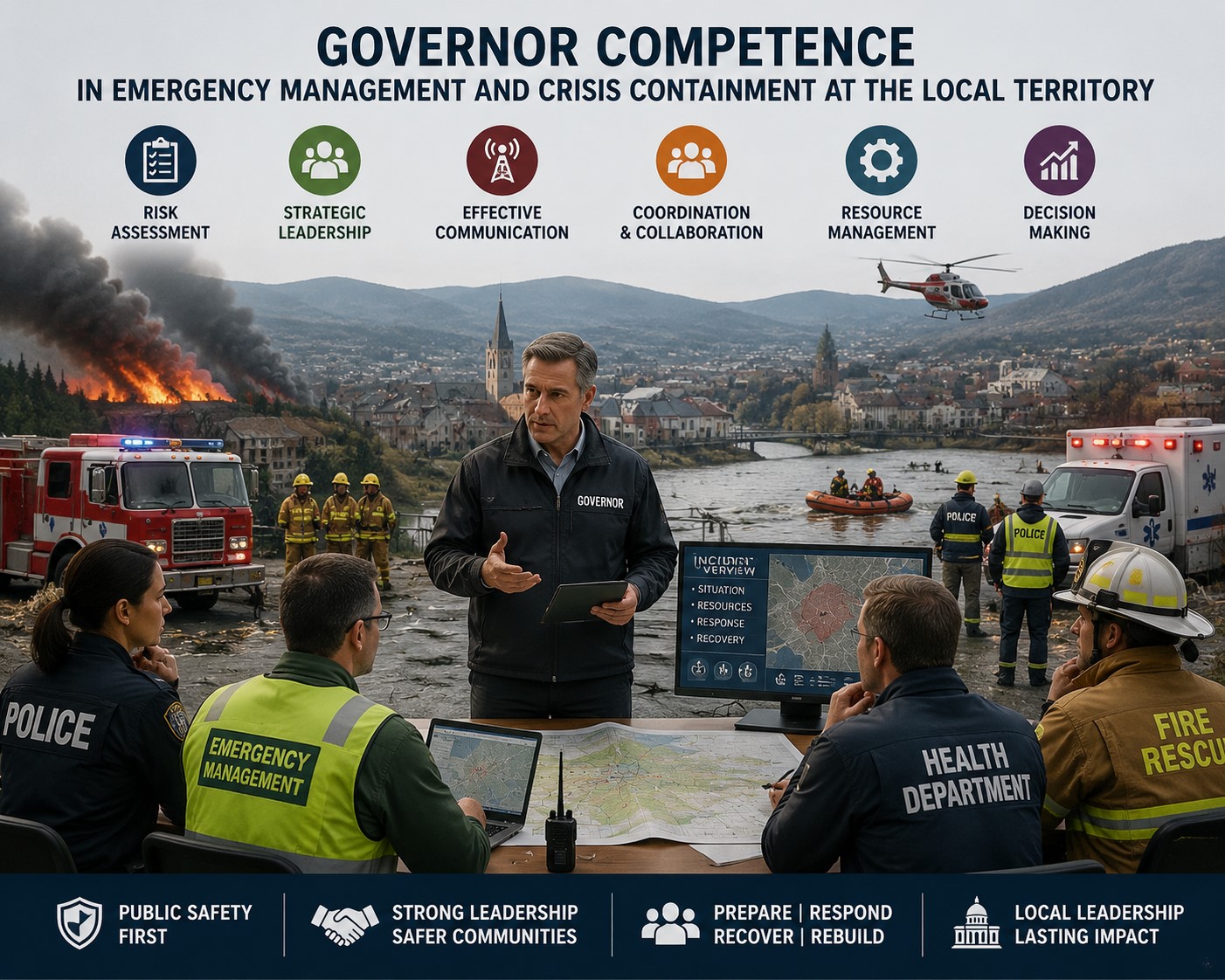
Governor Competence in Emergency Management and Crisis Containment at the Local Territory

Document Type : Original Article

Author

PhD in Islamic Jurisprudence and Law

10.5281/zenodo.24289477
Abstract
This article examines the legal competence of Iranian governors in managing emergency situations and containing crises within the local territory. The study adopts a descriptive and analytical legal approach and relies on the Constitution of the Islamic Republic of Iran, the Law on the Definitions and Criteria of Country Divisions, the National Crisis Management Law of ۲۰۱۹, the executive regulations concerning the duties and powers of governors and governors general, and other relevant rules governing public administration, civil protection, inter institutional coordination, and the maintenance of public order. The findings indicate that governors, as the highest representatives of the central government at the provincial level and as chairs of provincial crisis management headquarters, possess important responsibilities in risk reduction, preparedness, coordination of executive agencies, mobilization of public resources, organization of emergency response, supervision of relief operations, protection of public safety, and restoration of essential services. Their competence is therefore not limited to administrative supervision but extends to operational leadership and decision making in situations requiring rapid, coordinated, and legally accountable action. Nevertheless, the effective exercise of these powers depends on the observance of the principles of legality, proportionality, accountability, inter institutional cooperation, protection of citizens’ rights, and respect for the distribution of authority between national, provincial, and local institutions. The article concludes that strengthening the professional, legal, organizational, and decision making capacities of governors, clarifying overlapping jurisdictions, improving coordination with the National Crisis Management Organization, and establishing transparent mechanisms for supervision and accountability are essential for effective local crisis governance in Iran.

Graphical Abstract

Governor Competence in Emergency Management and Crisis Containment at the Local Territory

Keywords

Subjects

[1]    Ahmadi, H. (2021). Legal foundations of local crisis governance in Iran. Tehran: Mizan.
[2]    Ahmadi, H. (2023). Institutional coordination in disaster response: Iranian perspectives. Tehran: Mizan.
[3]    Comfort, L. K. (2018). Designing resilience for extreme events. Pittsburgh: University of Pittsburgh Press.
[4]    Constitution of the Islamic Republic of Iran. (1989). Tehran: Islamic Consultative Assembly.
[5]    Coppola, D. P. (2021). Introduction to international disaster management. Oxford: Butterworth-Heinemann.
[6]    Habibi, M. (2020). Crisis management and local administration in Iran. Tehran: Samt.
[7]    Jafari, A. (2021). Emergency powers of local authorities. Journal of Public Law Studies, 51(2), 231-252.
[8]    Jafari, A. (2023). The governor and the county crisis headquarters. Tehran: Mizan.
[9]    Karimi, M. (2022). Disaster law and administrative accountability. Journal of Administrative Law, 9(1), 41-63.
[10] Katouzian, N. (2015). Administrative law. Tehran: Sahami Enteshar.
[11] Katouzian, N. (2022). General principles of administrative law. Tehran: Sahami Enteshar.
[12] Law on the Definitions and Criteria of Country Divisions. (1991). Tehran: Islamic Consultative Assembly.
[13] Mousavi, S. F. (2022). Legal framework of crisis management in Iran. Journal of Legal Research, 14(3), 77-99.
[14] Mousavi, S. F. (2023). Public liability in emergency operations. Tehran: Mizan.
[15] National Crisis Management Law. (2019). Tehran: Islamic Republic of Iran.
[16] Regulation on the Duties and Powers of Governors General and Governors. (1998). Tehran: Supreme Administrative Council.
[17] Research Center of the Islamic Consultative Assembly. (2019). Report on the National Crisis Management Law. Tehran: Research Center of the Islamic Consultative Assembly.
[18] Rezaei, M. (2024). Operational command and legal limits. Journal of Criminal Law and Criminology, 12(1), 33-58.
[19] Sharifi, R. (2024). Local disaster preparedness and public safety. Tehran: Samt.
[20] United Nations Office for Disaster Risk Reduction. (2015). Sendai Framework for Disaster Risk Reduction 2015-2030. Geneva: United Nations.